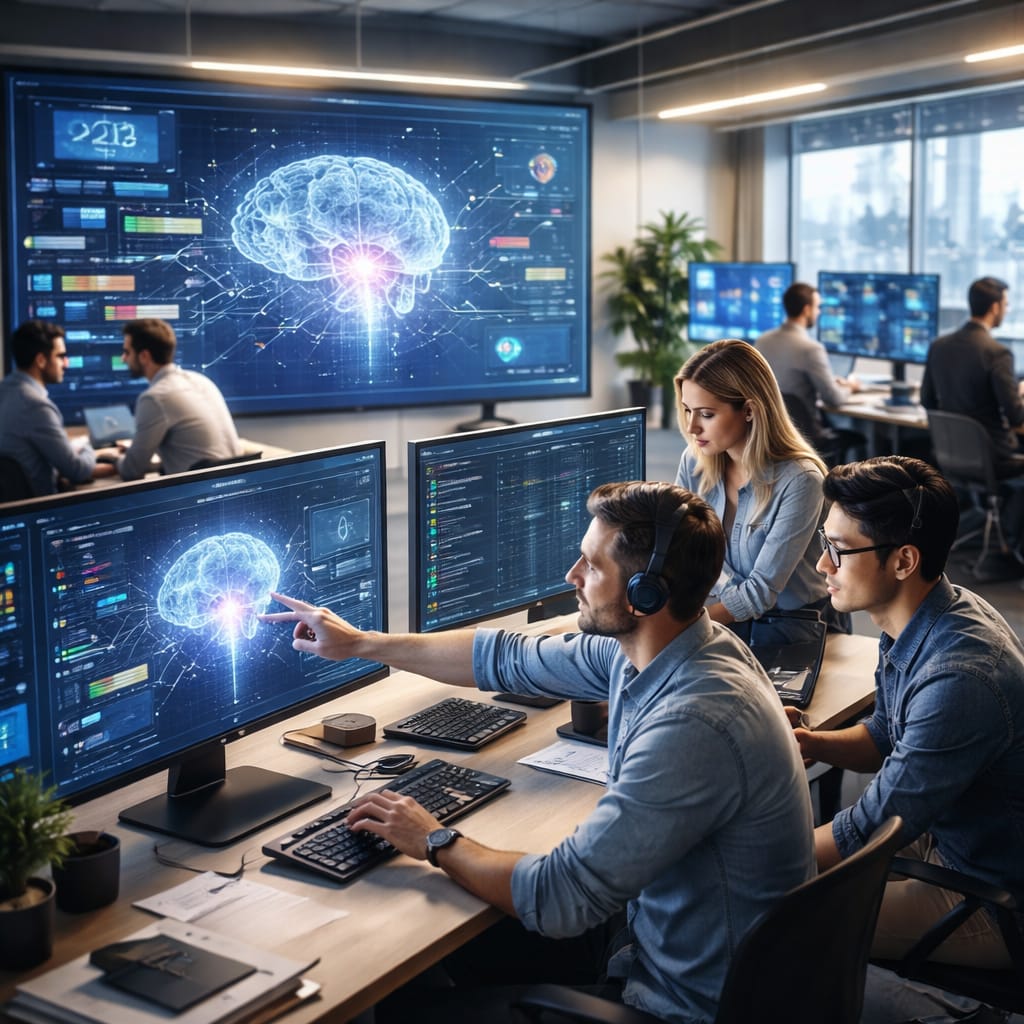
2026 Software Development Strategies: Leveraging AI for Success
Understanding 2026 Software Development Strategies
By 2026, software development strategies will be defined by how effectively teams operationalise AI across the entire lifecycle, from discovery to production support. In Australia, engineering leaders are moving beyond pilots and proofs of concept to embed AI Software Development into standard delivery methodologies and governance. This shift is driven by rising system complexity, tighter regulatory scrutiny, and expectations for near real-time feature delivery. Organisations are redesigning their SDLC so that AI systems participate as persistent “co-engineers” rather than ad hoc tools. As a result, delivery managers must rethink metrics, risk models, and quality gates to reflect AI-generated artefacts. Teams that invest early in data foundations, model governance, and robust tooling will outpace those relying on manual-only processes. These 2026 software development strategies make AI an integrated capability, not a bolt-on experiment.
Modern 2026 software development strategies start by embedding AI into planning, estimation, and requirements refinement. Product teams increasingly translate high-level epics into detailed user stories with the support of custom AI applications tuned to their domain language and architecture patterns. During implementation, coding assistants offer boilerplate, refactor suggestions, and inline documentation while preserving organisation-specific style guides. Quality engineers rely on automated testing with AI to generate regression suites, fuzz test critical APIs, and prioritise high-risk scenarios. In production, observability platforms apply machine learning in coding operations to correlate logs, traces, and metrics, surfacing anomalies before they affect end users. This creates a feedback loop where incidents reinforce training data and continuously improve detection models. The net effect is faster delivery with more predictable reliability when coupled with disciplined engineering leadership.
These transformations require a deliberate approach to guardrails and accountability. Unbounded use of generative tools can increase rework, security exposure, and technical debt, particularly in regulated Australian sectors such as financial services and healthcare. To maintain control, organisations define explicit policies for what AI can and cannot generate, especially around cryptography, authentication flows, and data handling logic. Teams treat intelligent software development as a shared responsibility across engineering, security, and risk functions. They establish review checklists that include provenance, licensing checks, and model confidence thresholds before merge. Governance forums monitor AI usage telemetry, model drift, and policy exceptions to ensure compliance with internal standards and external regulations. This structured practice transforms AI from a productivity gamble into a dependable asset.
Architecting for Intelligent, Secure Delivery
Security-centric architecture is central to 2026 software development strategies, especially as AI-generated code becomes ubiquitous. Architects now assume that AI contributions are untrusted by default and must pass hardened security controls. Pipelines integrate static and dynamic analysis tuned for prompt-injection patterns, insecure API usage, and data leakage risks. Engineering teams leverage AI-assisted software architecture to evaluate trade-offs in scalability, resilience, and cost while still applying human judgment for final decisions. In parallel, platform engineers design reference implementations that encode secure-by-design patterns for identity, secrets management, and data encryption. This combination of automated checks and opinionated blueprints significantly reduces the probability that unsafe AI-generated snippets reach production.
- Define organisation-wide coding and security standards explicitly covering AI-generated artefacts.
- Adopt scalable AI engineering practices that standardise prompts, datasets, and evaluation metrics.
- Use AI-powered code optimization selectively on performance-critical services with rigorous benchmarking.
- Implement continuous compliance monitoring for data residency and privacy in Australian and global regions.
- Invest in future-ready AI dev tools that expose audit logs, policy controls, and explainability features.

High-performing Australian teams are also reconfiguring operating models to maximise the value of AI in engineering. Cross-functional pods now include ML engineers or prompt specialists who curate datasets, manage fine-tuning, and interpret evaluation metrics. Delivery leads integrate AI-driven development workflows into sprint ceremonies, defining explicit acceptance criteria for AI-generated outputs. Capability uplift programs teach developers how to interrogate model outputs, identify hallucinations, and reason about probabilistic behaviour. In parallel, platform squads enable self-service experimentation environments with guardrails to prevent data exfiltration or cost blowouts. This organisational design creates a sustainable foundation where AI accelerates delivery while preserving safety, compliance, and technical excellence.
Treat AI as a powerful but untrusted team member: give it structured tasks, instrument its outputs rigorously, and keep experienced engineers firmly in control of final decisions.
Building an Enterprise AI Software Strategy for 2026
A coherent enterprise AI software strategy underpins all effective 2026 software development strategies in Australia. Executives set clear objectives for where AI should drive value, from reducing cycle time and incident rates to enabling new digital products. Roadmaps prioritise domains with strong data foundations and measurable outcomes, avoiding unfocused experimentation. Governance frameworks define ownership for model lifecycle management, prompt libraries, and compliance reporting across jurisdictions. Procurement policies evaluate AI platforms for privacy, sovereignty, and interoperability with existing DevSecOps stacks. By aligning architecture, operating model, and governance, organisations create an environment where AI enhances software delivery at scale while meeting stringent Australian regulatory expectations.
To put these strategies into practice, Australian enterprises should start with focused pilots in well-bounded services, then progressively industrialise successful patterns. Measure impact using engineering metrics such as lead time, change failure rate, defect density, and recovery time, not only subjective productivity impressions. Consolidate learnings into reusable playbooks, templates, and platform capabilities that any squad can adopt with minimal friction. As maturity grows, expand AI usage into more complex domains while maintaining human oversight for high-risk changes and customer-facing logic. Organisations that invest now in disciplined, AI-first engineering practices will be best placed to deliver secure, resilient, and innovative software in 2026 and beyond. For guidance on designing and implementing these approaches, contact our team today to assess your current SDLC and define a pragmatic AI-enabled transformation roadmap.