
AI Software Development in 2026: How Intelligent Tools Are Transforming Engineering
The rise of AI Software Development in modern engineering
In 2026, AI Software Development is reshaping how Australian engineering teams design, build, and ship applications at scale. From planning to production, AI-driven platforms now sit at the core of intelligent software development practices, augmenting rather than replacing human expertise. Developers increasingly rely on AI models to analyse large codebases, suggest improvements, and enforce architectural standards. This shift is particularly visible in complex enterprise environments, where automation reduces operational risk and accelerates delivery. As these tools mature, teams are learning when to trust automated suggestions and when to rely on senior engineering judgment. The result is a more data-informed, measurable approach to software quality and delivery. For Australian organisations, this evolution is becoming a key competitive differentiator in digital transformation programs.
One of the most visible changes is the growth of custom AI applications embedded directly in the development toolchain. Rather than generic, one-size-fits-all models, teams are training AI on their own repositories, coding standards, and domain-specific patterns. This allows assistants to propose solutions aligned with internal architecture guidelines and regulatory constraints. Organisations can codify best practices in a form that is continuously available to every engineer. As adoption grows, leadership is focusing on governance frameworks to control model access, training data, and auditability. When designed correctly, this approach reduces onboarding time and mitigates knowledge silos. It also establishes a virtuous cycle where every new project further improves the capability of the AI layer.
Automated code generation has moved beyond simple boilerplate, with AI-powered coding assistants capable of scaffolding full services, APIs, and infrastructure configurations. These systems interpret high-level requirements, infer edge cases, and produce implementation-ready code with integrated tests. Teams use them to prototype features quickly, explore architectural options, and reduce repetitive work. However, responsible organisations treat generated code as a starting point, subject to review, refactoring, and security hardening. Investing in AI code generation best practices ensures style consistency, maintainability, and alignment with performance requirements. When integrated into peer review workflows, automated suggestions become a catalyst for faster learning. This combination of speed and oversight is critical for safety-critical or regulated Australian industries.
AI-optimised debugging, testing, and CI/CD pipelines
Debugging and quality assurance have been transformed by AI-driven development workflows that continuously analyse logs, traces, and telemetry. Models detect anomalous patterns, correlate failures across services, and propose probable root causes. Instead of manually combing through stack traces, engineers receive ranked hypotheses with contextual evidence. This drastically reduces mean time to resolution, particularly in distributed microservice environments. In parallel, machine learning in dev tools predicts fragile components before they fail in production. Australian teams are combining these insights with observability platforms to build self-healing systems. The focus is shifting from reactive firefighting to proactive resilience engineering. Over time, this approach materially improves uptime, user experience, and operational cost profiles.
Testing is equally affected, with teams increasingly automating software testing with AI to generate scenarios that mirror real-world user behaviour. Models synthesize test cases by learning from production traffic, historical defects, and UX analytics. This enables broader coverage without a linear increase in manual test design effort. AI-based test prioritisation identifies the smallest set of cases needed to validate high-risk changes. In CI/CD pipelines, this translates into faster feedback loops and safer deployments. For Australian organisations operating across multiple devices, regions, and network conditions, AI-enhanced testing is becoming essential. It reduces regression risk while keeping release cycles short. Combined with feature flags and canary releases, it supports a more experimental, data-driven delivery culture.
- AI code generation best practices for maintainable, secure codebases
- AI-powered optimisation of CI/CD pipelines and deployment strategies
- Real-time security monitoring using behavioural anomaly detection
- Predictive project planning and resource allocation with AI analytics
- Assisted UX research and interface design grounded in user behaviour data
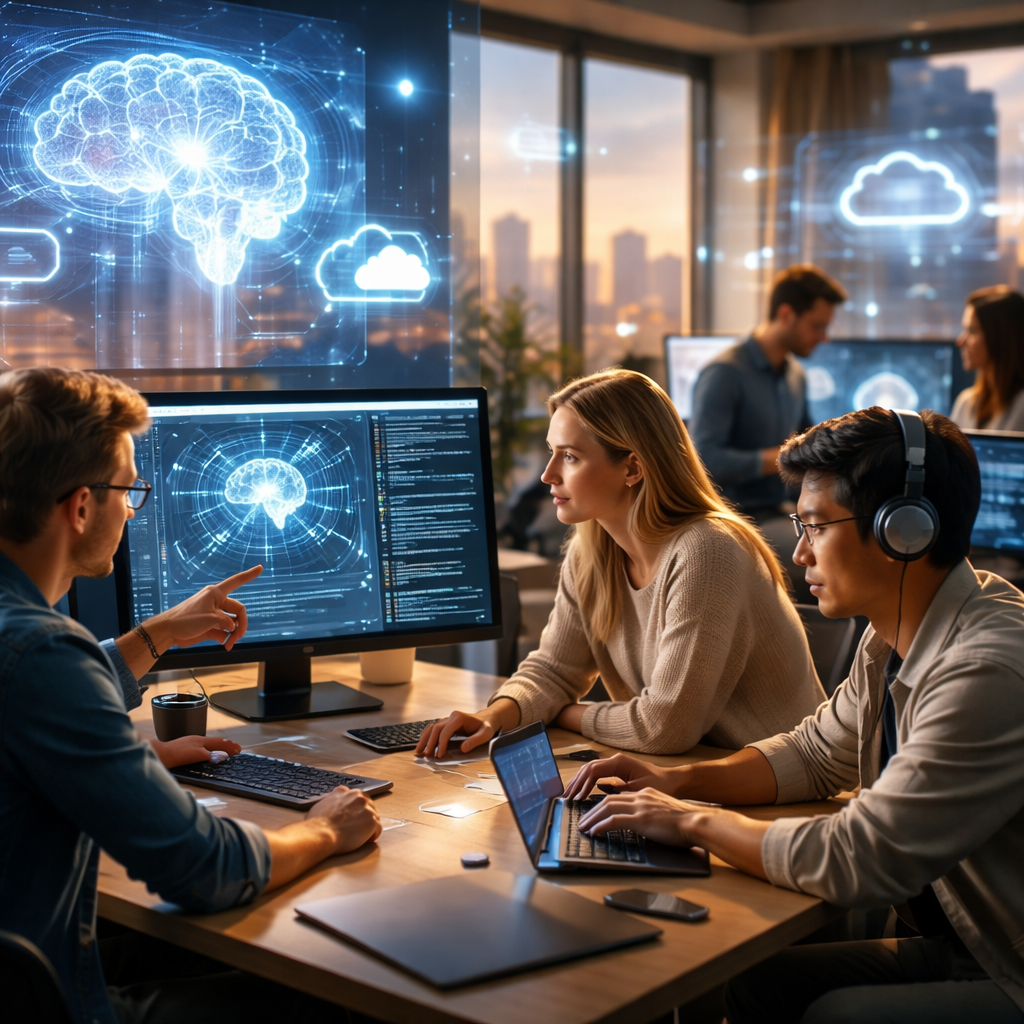
Natural language interfaces are further lowering barriers to complex tooling, enabling engineers to describe desired environments, dashboards, or data queries conversationally. In Australian teams with mixed skill levels, this reduces reliance on niche specialists for everyday tasks. It also makes domain experts outside engineering more capable of contributing to technical discussions. At the same time, leaders are investing in training to ensure staff understand the limitations and failure modes of language-based tools. Clear guidelines help prevent over-reliance on confident but incorrect outputs. By pairing conversational interfaces with robust review mechanisms, organisations maintain engineering rigour. Ultimately, these capabilities expand the range of people who can safely interact with production-grade platforms.
The real competitive advantage in 2026 does not come from adopting AI tools alone, but from embedding ethical AI in development workflows, governance, and culture so that human judgment and machine intelligence reinforce each other.
Security, ethics, and the future of AI software
Security teams now lean heavily on continuous monitoring systems powered by machine learning in dev tools to detect threats and misconfigurations in real time. Models baseline normal behaviour for services and users, triggering alerts only when patterns deviate meaningfully. This reduces noise compared to traditional signature-based systems and helps surface subtle, long-running attacks. When combined with automated remediation playbooks, low-risk issues can be resolved without human intervention. However, high-impact decisions still require expert review to avoid unintended consequences. As Australian organisations comply with evolving privacy and cyber regulations, explainability and auditable decision trails become critical. Structuring security workflows around human-in-the-loop oversight balances speed with accountability. This approach is fast becoming standard practice across regulated sectors.
Looking ahead, the future of AI software in Australia depends on how responsibly leaders invest in tooling, skills, and governance. Organisations that treat AI as a strategic capability rather than a tactical shortcut will see the greatest gains. This includes establishing clear policies for training data selection, model versioning, and bias monitoring. It also means aligning AI initiatives with broader architectural roadmaps, rather than creating disconnected point solutions. As teams gain experience, they will refine how they are scaling software teams with AI across disciplines, from product management to site reliability. Now is the time for engineering leaders to assess their maturity, define a roadmap, and pilot targeted use cases. To explore how these patterns could apply in your environment, start a structured assessment of your current toolchain and delivery practices today.