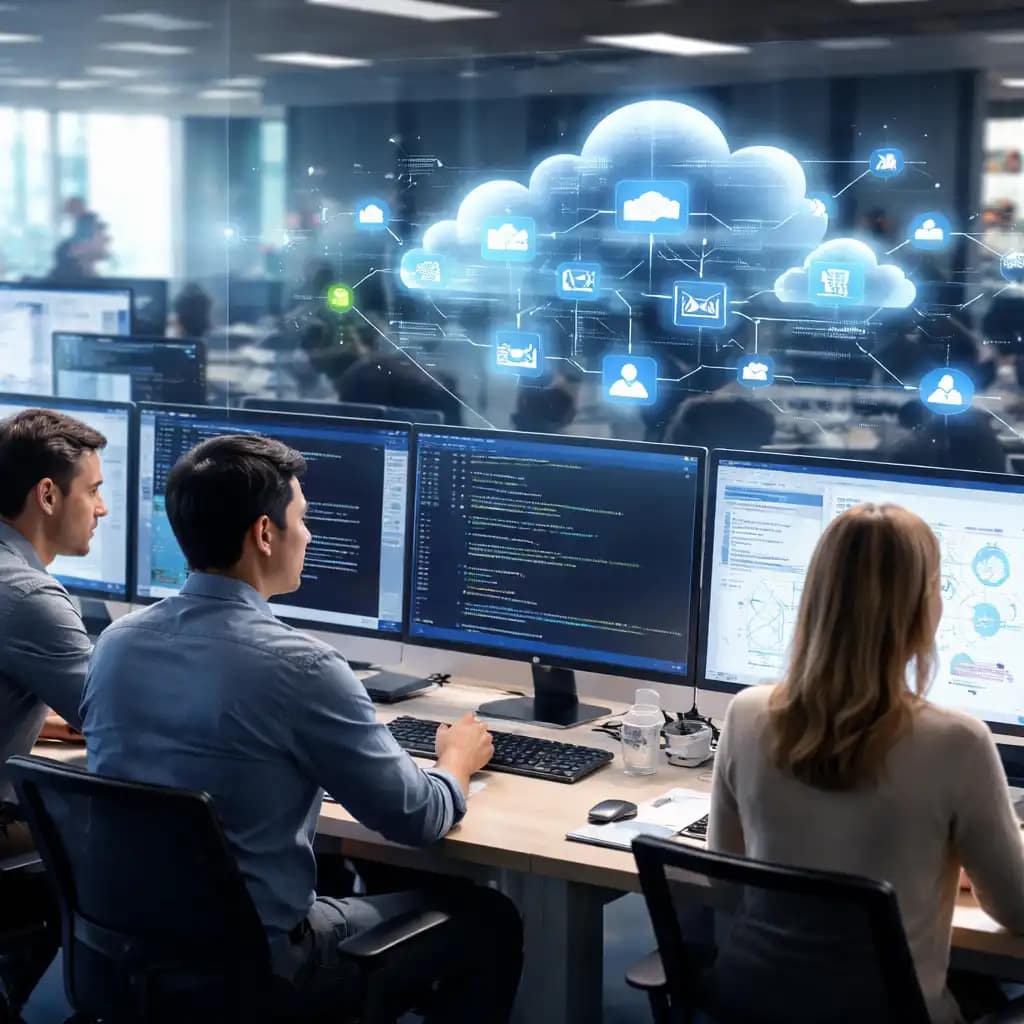
The Evolution of Software Development with AI in 2026
The Evolution of Software Development with AI in 2026
The Evolution of Software Development with AI in 2026 is reshaping how Australian teams design, build and operate digital products. Within the first stages of any project, AI-powered development tools now help engineers translate requirements into clean, consistent code while preserving architectural intent. Many organisations are experimenting with custom AI applications that automate repetitive implementation tasks and generate documentation in real time. As these capabilities mature, leaders are rethinking delivery models, governance frameworks and skills pathways for their engineering workforce. Developers still own technical decisions, yet they increasingly supervise and validate AI-generated changes rather than authoring every line themselves. This new balance demands stronger fundamentals in algorithms, security and distributed systems, not less. It also requires careful alignment between business stakeholders and engineering to ensure AI supports long-term strategic goals.
Across modern delivery pipelines, intelligent software development practices are driven by data from repositories, issue trackers and production telemetry. Platforms offering AI Software Development features mine this data to recommend refactorings, identify dead code and standardise patterns across large portfolios. When integrated into pull request workflows, these systems provide automatic review comments on complexity, style and potential defects. Teams can configure rules so that suggestions reflect their specific domain, regulatory obligations and risk appetite. In turn, this reduces technical debt, shortens onboarding for new engineers and improves the predictability of releases. Forward-leaning organisations are also building internal model catalogues that encapsulate proprietary knowledge and architectural blueprints. Over time, these assets become a strategic differentiator, accelerating delivery while preserving quality and resilience.
Testing and quality assurance are undergoing a similarly profound shift as teams embrace automating software testing with AI. Generative models can synthesise realistic test data, scenario-based test cases and even edge conditions that manual testers might overlook. Observability platforms apply machine learning in devops environments to correlate logs, metrics and traces, quickly localising failures in complex microservice architectures. When issues are detected, AI can propose candidate fixes or highlight the smallest change sets likely to resolve the defect. This shortens mean time to resolution and reduces the cognitive load on incident responders. At the same time, quality engineers are focusing more on test strategy, risk modelling and governance of test data. Together, these developments are redefining how reliability is designed, validated and sustained across the lifecycle.
AI-Driven Security, Compliance and Delivery in 2026
Security teams increasingly depend on AI-powered development tools to maintain visibility across sprawling codebases, dependencies and infrastructure-as-code definitions. Modern platforms continuously scan for known vulnerabilities, misconfigurations and suspicious patterns that hint at potential supply chain compromise. They also prioritise findings based on exploitability, business impact and exposure windows, so engineers can address the most critical risks first. Organisations experimenting with AI-assisted programming workflows are encoding compliance rules as machine-readable policies enforced automatically in pipelines. This shift reduces manual review effort while strengthening assurance that every change meets regulatory, privacy and internal governance standards.
- Use AI to standardise coding conventions and architectural patterns across large engineering teams.
- Leverage AI-driven app development to rapidly prototype features and validate user journeys.
- Adopt next-generation AI software analytics to identify performance bottlenecks early.
- Integrate scalable AI development pipelines with existing CI/CD platforms for consistent governance.
- Continuously train models on production feedback to keep recommendations aligned with real-world usage.

As organisations accelerate towards the future of AI coding, the role of the developer is evolving from sole author to critical decision-maker and curator. Engineers configure, evaluate and refine models, ensuring their outputs remain accurate, secure and aligned with user needs. Many teams are adopting design reviews that explicitly consider how AI-generated components interact with manually written modules. This encourages deeper discussion of edge cases, resilience patterns and observability requirements. When implemented thoughtfully, AI can reduce cognitive overhead, allowing developers to spend more time on innovation, experimentation and long-term architectural thinking rather than repetitive tasks.
In 2026, the teams that gain the most from AI are not those who replace engineers, but those who equip them with trustworthy, well-governed AI capabilities.
Preparing Your Organisation for AI‑First Software Delivery
Realising the full benefits of The Evolution of Software Development with AI in 2026 requires more than adopting new tools; it demands deliberate investment in people, platforms and processes. Leaders should define a clear roadmap for integrating AI into planning, implementation, testing and operations, supported by robust ethics and governance frameworks. Training programs need to cover prompt engineering, model evaluation and secure usage patterns, alongside core software engineering skills. Pilot initiatives should start with low-risk domains to validate assumptions before expanding into mission-critical systems. To move confidently, consider partnering with experienced providers in AI Software Development who understand regulatory expectations, cloud-native architectures and sector-specific constraints. By acting now, Australian organisations can build durable, AI-enabled engineering capabilities that deliver reliable, secure and user-centric software at scale.