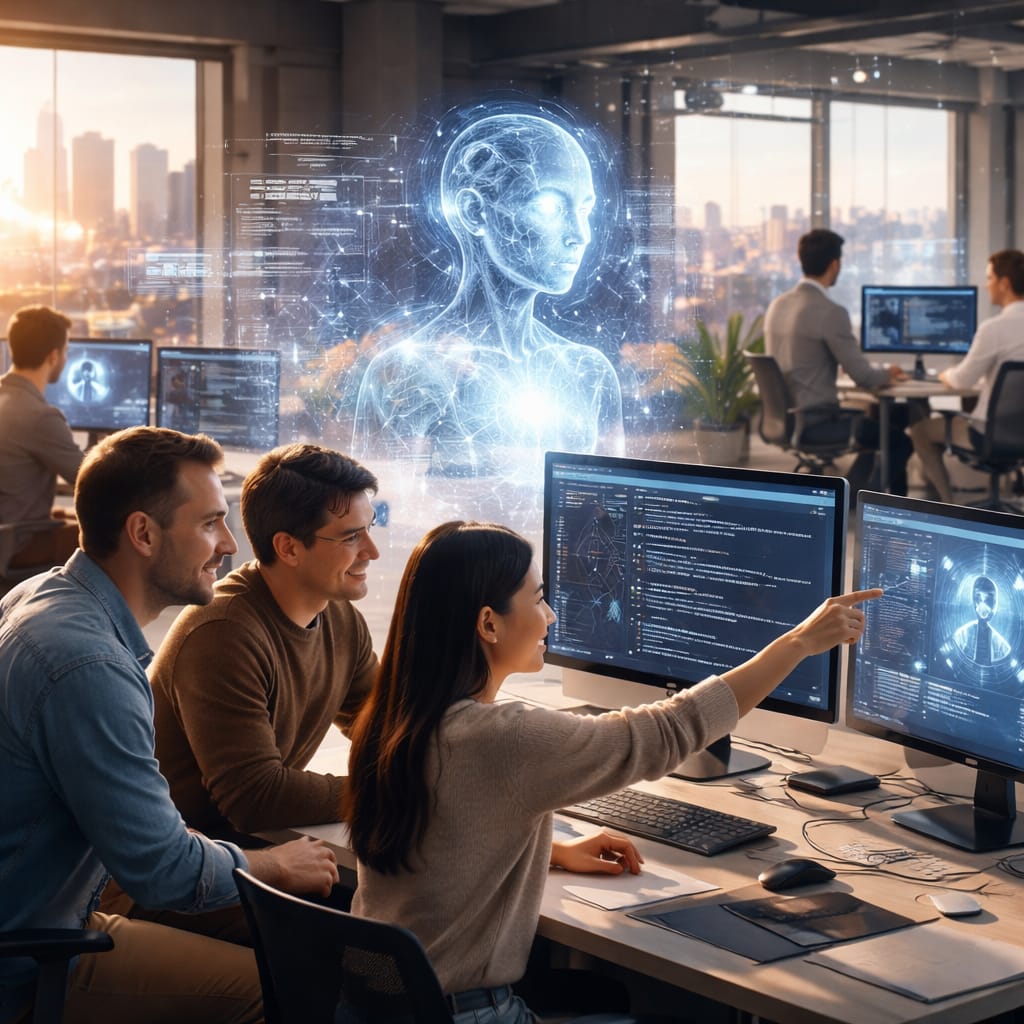
2026 Predictions: AI’s Influence on Software Development Trends
AI-Accelerated Development Pipelines
By 2026, AI’s influence on software development trends will be most visible in highly automated delivery pipelines across Australian engineering teams. Modern CI/CD systems will embed AI Software Development tools that automatically handle code quality checks, dependency upgrades, and configuration validation before every release. AI-powered DevOps workflows will correlate build logs, infrastructure metrics, and deployment histories to predict release risk in real time. These capabilities will reduce failed deployments, shorten change lead times, and increase confidence in frequent releases. For Australian organisations balancing legacy platforms and cloud-native services, AI-enhanced orchestration will become essential to maintaining reliability and compliance at scale.
As pipelines become more autonomous, AI will also assist with capacity planning and cost optimisation across multi-cloud environments. Models trained on historical load patterns will forecast infrastructure demand, allowing teams to right-size clusters before traffic spikes. In parallel, AI observability tools will continuously analyse traces and logs to surface performance regressions within minutes of a deployment. Rather than manually tuning thresholds, engineers will supervise adaptive alerting policies that learn from incident post-mortems and evolving architectures. This shift will free senior engineers to focus on strategic platform design while AI systems manage routine operational adjustments. Ultimately, Australians building large-scale digital services will treat AI as a co-pilot for platform reliability engineering.
In this environment, custom AI applications will sit alongside traditional build tools, providing domain-specific insights for sectors like finance, health, and government. Teams will embed machine learning in app development workflows to tailor alerts and recommendations to industry-specific risk profiles. For example, financial services platforms may use predictive AI in development pipelines to flag code changes that could affect transaction integrity or regulatory reporting. Government digital teams, meanwhile, will rely on intelligent software development dashboards that surface accessibility and privacy issues before public release. As these practices mature, the future of AI coding tools will be judged less on raw automation and more on how safely they support complex, regulated systems.
Automated Code Generation and Intelligent Testing
By 2026, automated code generation with AI will move from experimental prototypes to everyday practice in Australian software teams. Developers will describe features in structured natural language, and AI agents will convert those specifications into strongly typed modules, infrastructure-as-code templates, and API contracts. These systems will reference organisational coding standards, security baselines, and architectural blueprints to produce consistent, review-ready outputs. Rather than replacing engineers, this shift will reposition them as reviewers, curators, and integrators of AI-authored code. The most effective teams will treat AI as a junior developer whose work must always be validated against business rules and compliance obligations.
Alongside coding support, AI-assisted software testing will transform how quality is assured in complex systems. Test suites will be generated dynamically from code diffs, production telemetry, and historical defect patterns, ensuring coverage reflects real-world usage. Next-gen intelligent development tools will identify brittle tests, dead paths, and duplicated scenarios, proposing refactors that keep suites maintainable over time. In regulated Australian sectors, AI will also map tests back to explicit compliance controls, simplifying audit preparation and evidence gathering. By 2026, intelligent software development will mean that every significant change triggers a precisely targeted set of tests, dramatically reducing both flakiness and blind spots.
- AI-driven software engineering trends will normalise natural-language-to-code workflows for routine features and boilerplate.
- Intelligent test generation will leverage behavioural analytics to focus on the user journeys that matter most.
- Static analysis and dynamic testing will be orchestrated by unified AI agents that understand system topology.
- Secure coding practices will be enforced by AI models trained on real exploit data and sector-specific attack patterns.
- Engineers will increasingly curate test data and acceptance criteria rather than manually scripting every scenario.

Security, compliance, and governance will be designed into AI-enabled workflows rather than bolted on at release time. Australian organisations will deploy policy-driven guardrails that inspect prompts, generated code, and configuration changes for confidential data leakage and policy breaches. These guardrails will be critical to maintaining trust when using large language models inside highly regulated environments. For example, healthcare teams will configure AI to automatically anonymise clinical data used during development while preserving statistical utility. Over time, regulators are likely to reference such controls explicitly, making structured AI governance a prerequisite for major digital projects. Teams that invest early in governance patterns will find it easier to adopt emerging AI capabilities without triggering repeated risk assessments.
By 2026, the most competitive Australian software organisations will be those that pair disciplined engineering practices with carefully governed AI co-pilots across the entire delivery lifecycle.
Human-AI Collaboration and Strategic Impact
Human-AI collaboration will reshape engineering careers, but it will not eliminate the need for skilled developers in Australia. Engineers will specialise in orchestrating AI agents, validating outputs, and integrating domain context into intelligent workflows. Organisations will recognise that poor prompts and unclear business rules can undermine even the most advanced AI systems, investing in targeted training and experimentation time. As these capabilities mature, leaders will benchmark teams not only on delivery speed but also on how responsibly they apply AI across product, security, and operations. The organisations that adapt fastest will be those that treat AI as a socio-technical change, not just another tooling upgrade.
If your organisation is planning its roadmap for 2026 and beyond, now is the time to pilot AI-powered DevOps workflows and governance frameworks in parallel. Starting with narrow, high-value use cases—such as test generation, documentation, or log analysis—allows teams to build confidence without overexposing critical systems. As maturity grows, you can scale towards fully integrated AI platforms spanning planning, coding, testing, and operations. To stay ahead of the curve and harness these advances safely, consider partnering with specialists who understand both Australian regulatory expectations and cutting-edge engineering practice. Take the next step today by assessing where AI can reinforce your existing delivery strengths and designing a clear adoption strategy that your teams can trust.