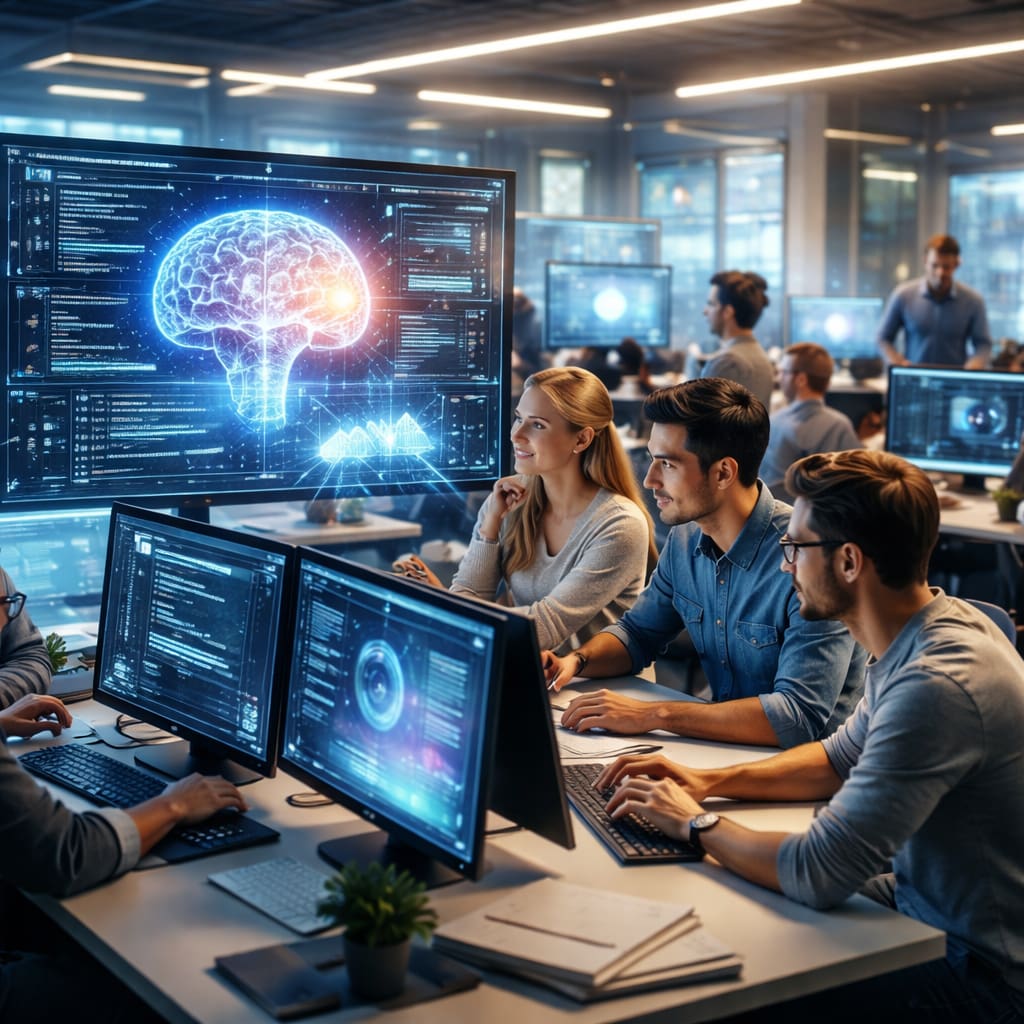
AI-Powered Development: Transforming Software in 2026
The Rise of AI-Powered Development in 2026
AI-powered development is rapidly transforming how Australian organisations design, build and operate production systems, with the primary shift driven by AI Software Development practices embedded across the full lifecycle. By 2026, advanced models, automation frameworks and policy-aware orchestration layers are standard components in enterprise engineering toolchains. Teams increasingly treat AI components as first-class collaborators, not just plugins, incorporating them into architecture decision records and risk registers. This shift is particularly visible in regulated sectors, where AI accelerates delivery while maintaining evidence trails for audits. Australian organisations are also consolidating fragmented pilots into unified platforms, reducing duplication and governance blind spots. As budgets tighten, leaders focus on use cases with measurable outcomes rather than speculative proofs of concept. The result is a more data-driven, outcome-focused engineering culture.
Across industries, engineering leaders are moving from opportunistic experimentation to deliberate platform strategies that support custom AI applications targeting specific business domains. Banks, hospitals and logistics providers increasingly maintain shared feature stores, prompt libraries and reusable policy templates to avoid reinventing the wheel. This convergence is reshaping skills expectations for developers, who now need fluency in model integration patterns as much as in traditional frameworks. At the same time, product managers are learning to scope features around model capabilities, latency budgets and data quality constraints. The cultural transition is not trivial, but organisations that invest in change management are seeing significant cycle-time reductions. As adoption matures, the distinction between “AI projects” and “normal projects” is beginning to disappear across high-performing Australian teams.
Within delivery teams, intelligent software development is emerging as the default mode of working rather than a niche practice. Planners, analysts and engineers anchor their workflows around AI-augmented backlogs, where user stories are enriched with suggested test scenarios, risk flags and dependency graphs. During implementation, developers pair with generative models that propose code structures, refactoring options and integration patterns while preserving existing architectural boundaries. Test engineers rely on autonomous agents that generate edge-case suites, track flaky tests and tune coverage thresholds over time. Operations teams, in turn, coordinate incidents through AI-assisted runbooks that synthesise telemetry and historical post-incident reviews. This end-to-end augmentation is reshaping what “full-stack” capability means inside modern Australian software organisations.
Core Capabilities Redefining Software Engineering
Modern AI platforms provide a toolkit of capabilities that collectively underpin AI-driven software engineering across complex environments. Natural language to code generation now extends beyond simple snippets to full-service templates, configuration files and contract tests aligned with architectural standards. Autonomous test generation agents maintain extensive regression libraries, automatically pruning obsolete cases as APIs evolve. Observability tooling integrates model telemetry, enabling teams to correlate user-facing issues with drift, data quality and inference-time anomalies. In parallel, predictive analytics engines assess sprint plans to identify schedule risks, skills gaps and dependency conflicts before they impact delivery. Security scanning models continuously inspect both code and prompts for leakage risks, insecure patterns and emerging vulnerabilities. These capabilities are increasingly delivered through standardised APIs and pipelines rather than bespoke integrations.
- Generative systems translate requirements into implementation-ready templates and initial test harnesses.
- Risk-aware assistants highlight architectural anti-patterns and deficit areas in documentation.
- Governance engines enforce policy-as-code across training, deployment and monitoring workflows.
- Continuous validation tools assess model performance against fairness, robustness and security criteria.
- Collaboration interfaces allow engineers, data scientists and compliance teams to share traceable decisions.

At the workflow level, teams are adopting AI-assisted app development workflows that standardise how models participate in everyday tasks. For example, pull request templates integrate automated reasoning steps that summarise changes, highlight potential regressions and map modifications to risk categories. Story refinement sessions use AI to propose acceptance criteria, data contracts and observability hooks aligned with organisational standards. During incident triage, assistants surface likely root causes and remediation snippets based on historical incidents and topology graphs. This orchestration reduces cognitive load, shortens feedback loops and allows specialists to concentrate on high-value design decisions. Australian organisations with distributed teams are finding these practices particularly beneficial for maintaining consistency and shared understanding.
In 2026, the most successful Australian engineering teams will be those that treat AI as an integrated capability across planning, implementation and operations, not as a separate experimental track.
Governance, Security and the Future of AI Coding Tools
Robust governance is essential as organisations explore the future of AI coding tools in regulated Australian sectors. Compliance teams now collaborate closely with engineering leadership to codify AI usage policies, including approved data sources, retention windows and redaction standards. Threat modelling extends beyond traditional vectors to cover data poisoning, prompt injection and covert exfiltration via chat interfaces. Model governance frameworks define clear ownership, versioning and rollback procedures for each AI capability deployed into production environments. Continuous monitoring pipelines track not only performance metrics but also fairness indicators and drift signals that might compromise decision quality. External audits increasingly expect evidence of reproducible experimentation and transparent escalation paths for model-related incidents. By embedding these practices early, organisations reduce the risk of costly retrofits and reputational damage.
Looking forward, Australian engineering leaders are benchmarking their platforms against next-generation AI dev platforms that emphasise interoperability, observability and policy compliance as core design principles. These platforms provide unified control planes for managing both conventional services and AI components, simplifying operations across hybrid and multi-cloud environments. They also expose fine-grained access controls, enabling teams to segregate experimentation sandboxes from production paths without impeding innovation. As adoption scales, the distinction between MLOps and traditional DevOps is narrowing into a consolidated discipline focused on secure, observable automation. Organisations that combine disciplined governance with pragmatic experimentation are best positioned to sustain momentum as the technology and regulatory landscape continues to evolve.
To prepare for this trajectory, many Australian firms are investing in targeted capability uplift programs covering machine learning in dev teams, secure prompt engineering and AI-aware architecture design. Dedicated enablement squads help product teams identify high-friction workflows suitable for augmentation, such as test generation, monitoring configuration or incident response. Internal communities of practice share patterns for automating code reviews with AI, standardising on shared rule sets and explainability requirements. Release engineering groups are piloting AI tools for faster deployment that optimise rollout windows, feature-flag strategies and rollback triggers based on telemetry. At the portfolio level, technology leaders are exploring strategies for scaling development with AI, balancing centralised platform investment with domain-specific autonomy. Organisations that act now will be better placed to navigate the next wave of AI capability and competitive pressure in the Australian market.
To harness AI-powered development effectively, consider running a structured assessment of current delivery practices, mapping opportunities for automation and augmentation across your pipelines. From there, you can prioritise initiatives with clear value hypotheses, such as reducing incident resolution time or improving test coverage in critical services. If you are ready to progress, engage our specialist team to design and implement a secure, compliant and scalable AI engineering platform tailored to your environment. We help Australian organisations integrate advanced capabilities into existing toolchains, align stakeholders around governance principles and deliver measurable outcomes. Contact us today to discuss your roadmap and accelerate your next wave of AI-enabled software delivery.