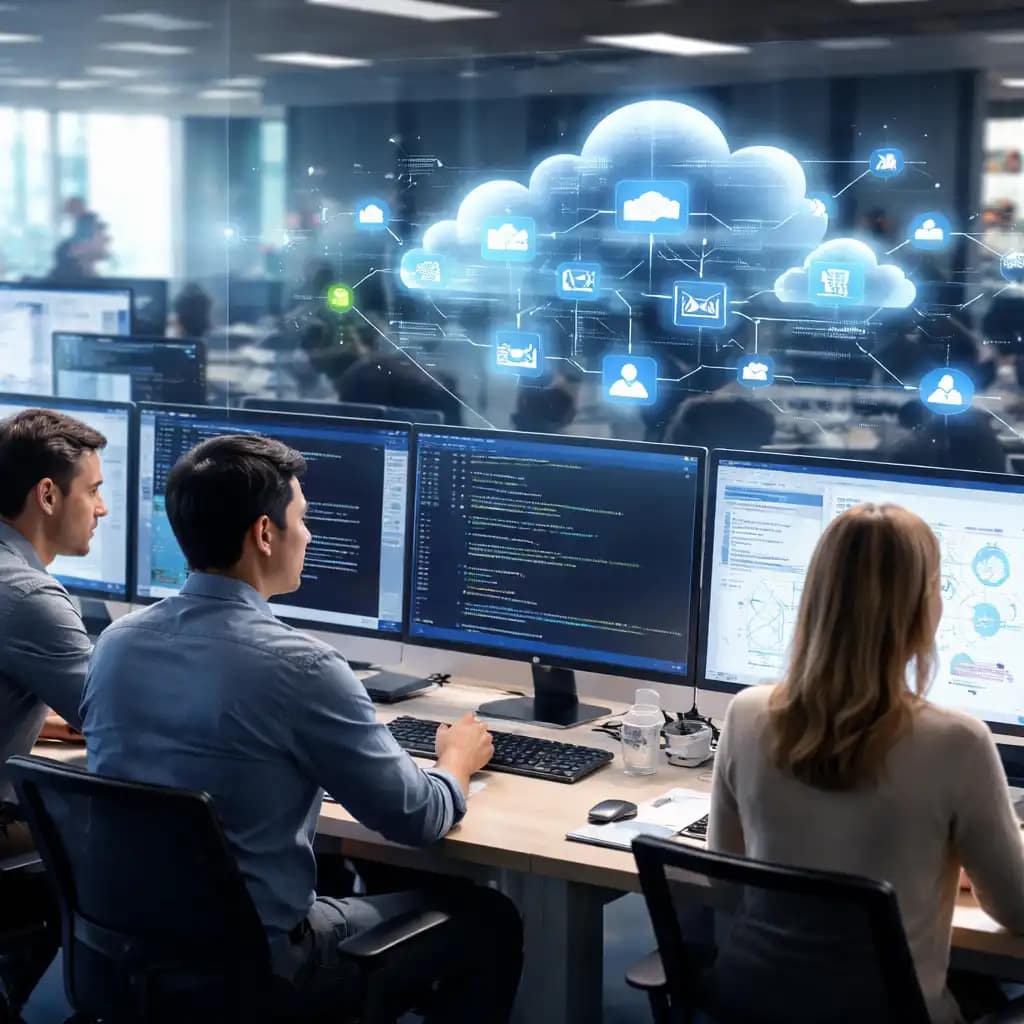
Harnessing AI for Enhanced Software Development in 2026
Harnessing AI for Enhanced Software Development in 2026
Harnessing AI for enhanced software development in 2026 is now a strategic necessity for Australian engineering teams rather than an optional experiment. Within the first days of adopting AI Software Development platforms, many organisations report measurable gains in delivery speed and code quality. Development environments increasingly embed AI-assisted code generation, intelligent refactoring, and inline documentation support. These capabilities are complemented by custom AI applications that integrate directly with version control, CI/CD, and issue tracking systems. As teams standardise on next-gen AI dev platforms, they unlock consistent patterns for security, governance, and performance optimisation. This shift is especially visible in cloud-native environments, where microservices and serverless functions benefit from continuous optimisation. For technology leaders, the question is no longer whether to adopt AI, but how to integrate it safely, systematically, and at scale.
Across the SDLC, intelligent software development practices are reshaping how architects, developers, and testers collaborate. During discovery and design, generative models transform raw stakeholder notes into structured specifications and candidate architectures. These systems can highlight dependencies, surface potential risks, and propose alternative designs anchored in historical delivery data. During implementation, AI-assisted code generation suggests idiomatic patterns aligned with team standards and existing libraries. Developers remain accountable for intent and correctness, but they increasingly operate as reviewers and orchestrators of AI outputs. In parallel, AI-powered development tools analyse repositories to detect code smells, security hotspots, and maintainability issues before they reach production. This end-to-end augmentation improves engineering throughput while preserving technical rigour.
Testing and quality engineering are experiencing some of the most dramatic improvements, particularly in automating software testing with AI at scale. Modern test suites can be generated, expanded, and continuously refined based on real usage data and failure patterns. Multi-agent systems perform regression analysis, fuzzing, and static checks as part of routine pipelines. When combined with machine learning in software observability stacks, this approach enables early detection of brittle contracts and performance regressions. Organisations that invest in AI-driven dev workflows often see reductions in defect leakage and shorter feedback cycles. These gains compound over time as AI models learn from each release, making the overall system more resilient.
From DevOps to AIOps in the Australian Engineering Context
As AI-generated code becomes commonplace, Australian teams are evolving from traditional DevOps towards AIOps-centric operating models. Toolchains now ingest telemetry from builds, deployments, and runtime environments to create adaptive baselines. When anomalies occur, AI systems correlate signals across logs, traces, and metrics to surface likely root causes. Incident responders receive prioritised alerts and suggested remediation steps, reducing noise and mean time to recovery. Some organisations pair these capabilities with AI-powered development tools that can automatically propose configuration fixes or rollout strategies. The result is a tighter feedback loop between development and operations, with AI acting as a continuous optimisation layer. This model supports scaling engineering teams with AI while maintaining high reliability and compliance. Over time, incident patterns inform architectural improvements and capacity planning decisions.
- Use AI-assisted code generation to standardise patterns and reduce boilerplate across services.
- Introduce autonomous quality gates that leverage AI for regression detection and security analysis.
- Adopt AIOps platforms that align with your cloud provider and observability stack.
- Define clear governance for data residency, model usage, and auditability from day one.
- Run targeted upskilling programs focused on prompt design, verification, and model limitations.

Governance, trust, and risk management sit at the core of harnessing AI for enhanced software development in 2026. Australian organisations must align AI usage with local privacy regulations, sector-specific standards, and internal security policies. Leading teams enforce human-in-the-loop review for high-impact changes, ensuring that AI suggestions are always subject to professional judgement. They also define clear provenance rules so that the origin of AI-generated artefacts is traceable during audits. These practices are vital as the future of AI coding converges with regulatory expectations around transparency and accountability. Mature environments codify these controls into policy-as-code, integrated directly into pipelines. By treating governance as an enabler rather than a blocker, teams can innovate quickly while staying within well-understood risk boundaries.
In 2026, high-performing engineering organisations are those that treat AI as a first-class capability, embedding it thoughtfully into every stage of the software delivery lifecycle.
Building a Future-Ready AI-Enhanced Engineering Organisation
To fully realise the benefits of harnessing AI for enhanced software development in 2026, leaders must invest in people, platforms, and process modernisation. Upskilling programs should cover prompt engineering, failure modes of generative models, and robust verification techniques. On the platform side, teams need secure, observable interfaces to next-gen AI dev platforms, with fine-grained access controls. Process updates should embed AI check points into design reviews, code review templates, and release governance. When these elements align, organisations can safely accelerate delivery, improve quality, and reduce operational toil. If your team is ready to explore how AI can modernise your pipelines and uplift engineering capability, talk to our AI experts today and begin designing your next generation of adaptive, resilient software systems.