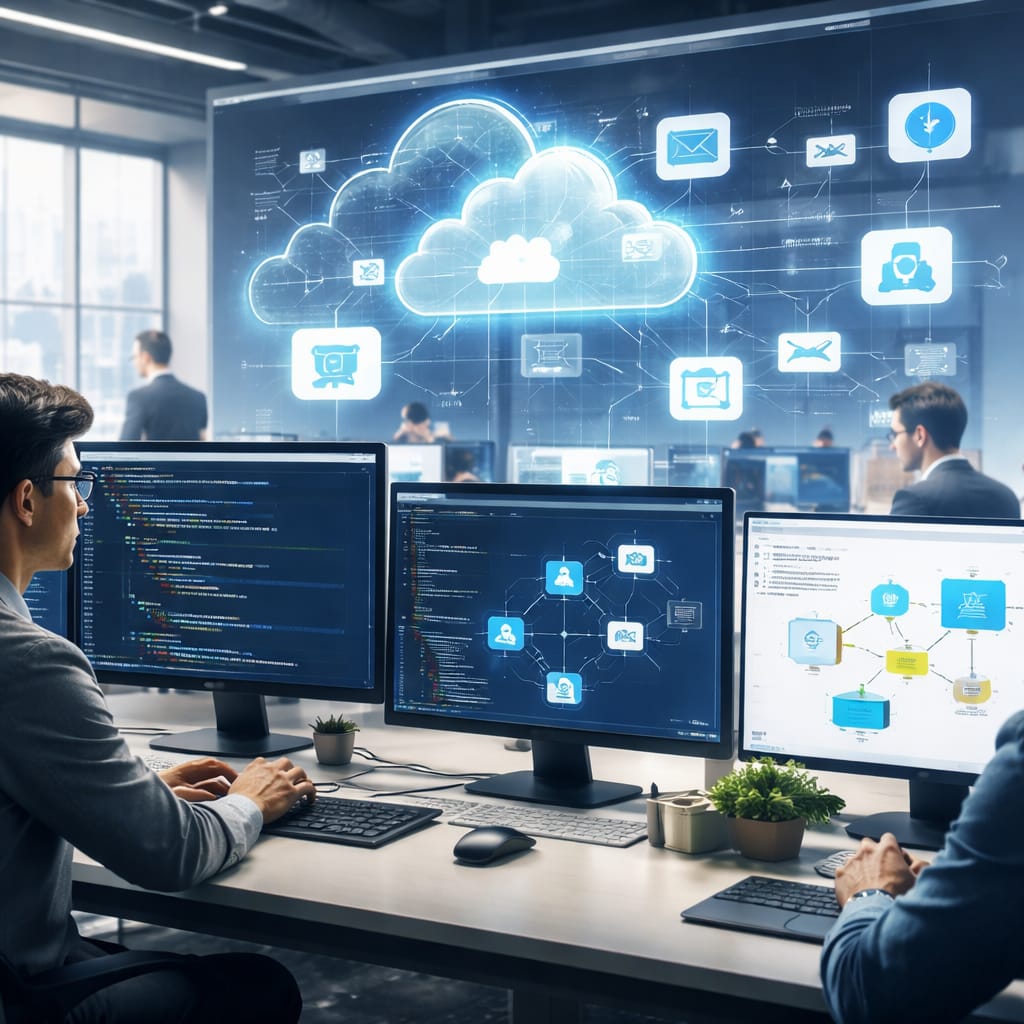
2026: The Transformative Power of AI in .NET Services
The Transformative Power of AI in .NET Services in 2026
By 2026, the transformative power of AI in .NET services is reshaping how Australian organisations design, deliver, and govern mission-critical systems. AI-native capabilities are now embedded from Microsoft.Extensions.AI and Semantic Kernel through to Visual Studio and GitHub Copilot, turning traditional .NET projects into adaptive, learning platforms. For teams delivering custom software solutions, AI integration is no longer experimental; it is a core architectural concern. Modern AI-driven .NET development patterns treat models, prompts, and vector stores as first-class components alongside APIs and databases. This shift is especially visible in regulated sectors, where explainability, observability, and compliance are designed in from day one. As a result, Australian enterprises are building intelligent custom .NET solutions that respond in real time to user behaviour and operational signals.
The introduction of Microsoft.Extensions.AI has standardised how engineers integrate large language models and embeddings into production-grade .NET workloads. With provider-agnostic abstractions, development teams can switch between Azure OpenAI, open models, or on-premise deployments without rewriting core logic. This flexibility underpins advanced capabilities such as retrieval-augmented generation, intelligent routing, and AI-led workflow orchestration. When combined with Semantic Kernel, developers can compose skills that chain together tools, prompts, and APIs into robust, testable pipelines. These patterns support both greenfield enterprise application development and brownfield enhancement of existing systems. In practice, Australian teams are embedding conversational agents into line-of-business portals, knowledge management platforms, and operations dashboards.
Vector Data Extensions and AI-oriented data libraries have become foundational to semantic search and personalisation in production .NET environments. By storing embeddings alongside traditional relational data, platforms can answer intent-based queries rather than relying solely on keywords or rigid filters. This approach significantly improves knowledge discovery for support teams, field technicians, and business analysts working across large document stores. For organisations building cloud-based .Net applications on Azure, these capabilities plug naturally into existing security, networking, and monitoring patterns. Engineers can expose semantic search endpoints, tune ranking behaviour, and log prompt interactions using the same practices applied to APIs and microservices.
Productivity Gains for Microsoft Development & .Net Services Teams
Development productivity has accelerated as AI copilots mature from basic autocomplete to context-aware engineering assistants. Visual Studio’s AI features analyse entire solutions, suggesting refactors, performance improvements, and safer patterns as developers work. In parallel, GitHub Copilot generates tests, scaffolds interfaces, and automates documentation, reducing the manual burden on senior engineers. These tools are particularly powerful when combined with established AI automation in .NET services pipelines, where code suggestions can be validated against extensive CI/CD test suites. Australian teams are reorganising their workflows so human expertise focuses on architecture and domain modelling, while AI handles repetitive or lower-value tasks.
- Automated generation of unit, integration, and property-based tests for complex .NET services.
- AI-assisted refactoring of legacy patterns into modern, resilient architectures.
- Proactive identification of performance bottlenecks and unsafe concurrency constructs.
- Continuous analysis of security hotspots aligned to secure coding guidelines.
- Domain-aware code suggestions trained on organisation-specific patterns and libraries.

Legacy landscapes remain a critical focus area, with AI dramatically reducing the risk profile of modernisation programs. AI-powered analysis can inventory dependencies, detect hidden coupling, and map data flows across sprawling solutions built on earlier .NET Framework versions. Tools guided by modernizing legacy .NET systems best practices then propose incremental migration paths instead of risky big-bang rewrites. In Australia, this is particularly important for government and financial services, where mission-critical workloads must remain available during transformation. AI-driven code translation and automated regression test generation preserve business logic while aligning implementations with current security and performance expectations.
Organisations that successfully harness AI in .NET services treat models, prompts, and telemetry as strategic assets, integrating them deeply into architecture decisions, engineering workflows, and operational governance.
Strategic Considerations for 2026 and Beyond
Realising the full benefits of AI in .NET services requires more than just adopting new libraries or IDE extensions. Technology leaders must embed responsible AI principles into solution design, including clear guardrails around data residency, privacy, and human oversight. Centralised observability platforms now ingest model telemetry, prompt traces, and vector store metrics alongside traditional logs and traces. This integrated view is essential for operating next-gen enterprise .NET platforms with predictable performance and cost. At the same time, engineering teams need structured training in prompt design, evaluation techniques, and the nuances of machine learning in .NET apps. Australian organisations that combine these capabilities with robust future-ready Microsoft development stack practices are best positioned to compete. To progress quickly, engage a specialist partner experienced in intelligent custom .NET solutions to assess your portfolio, shape an AI-first target architecture, and implement scalable .NET cloud architectures that support secure, cloud-native operations for the next decade.