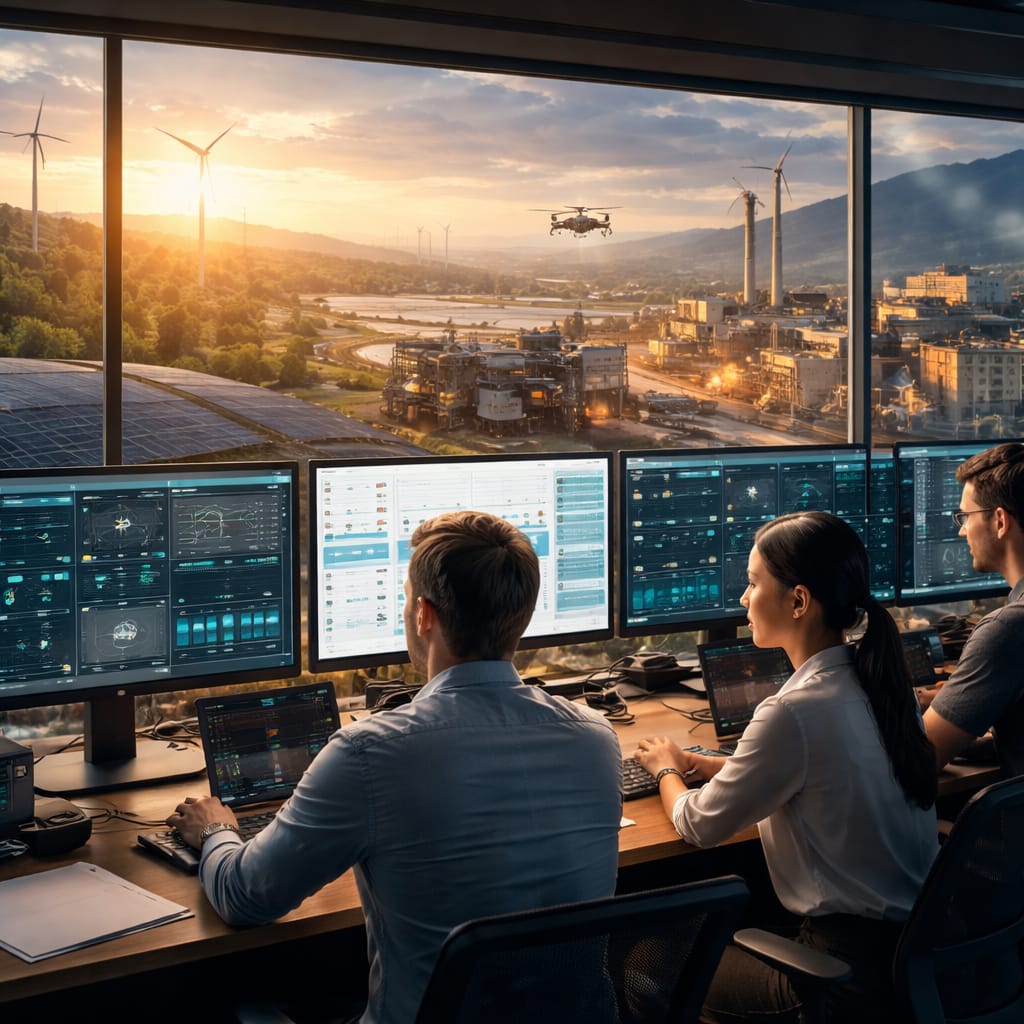
AI in Software Development: The Future of Predictive Maintenance in 2026
The role of AI in software development for predictive maintenance
AI in software development for predictive maintenance is transforming how Australian operators monitor critical assets and avoid costly shutdowns. By 2026, engineering teams are embedding AI Software Development practices directly into their maintenance platforms, linking industrial IoT data with robust analytics pipelines. Instead of relying solely on scheduled inspections, organisations can now anticipate failures days or weeks in advance using rich telemetry from sensors and control systems. This shift is especially important in mining, energy, and transport where unplanned downtime rapidly escalates into safety, environmental, and financial risk. Engineering leaders are also aligning maintenance strategies with production priorities, using AI-driven insights to decide when to run, derate, or shut down assets. As a result, maintenance teams move from reactive firefighting to proactive, risk-based intervention. Over time, this builds a culture where reliability, safety, and productivity are engineered together, not traded off.
Under the hood, AI-powered predictive maintenance tools combine time-series models, anomaly detection, and root-cause analysis to provide clear, actionable recommendations. Rather than just raising raw alarms, platforms consolidate signals into concise alerts that highlight likely failure modes and confidence levels. This helps planners decide whether to schedule work immediately or continue monitoring under controlled conditions. In many Australian operations, custom AI applications are integrated with CMMS or EAM systems so that work orders, spare parts reservations, and permits are triggered automatically. This automation shortens the time between detection and response without bypassing human oversight. Continuous feedback from technicians then flows back into the models, refining accuracy with each maintenance cycle. Such closed-loop workflows ensure that AI remains grounded in real-world operating conditions and practical constraints on-site.
To manage this complexity at scale, intelligent software development practices are critical, spanning architecture, security, and lifecycle management. Engineers design modular services that separate data ingestion, feature computation, model serving, and visualisation layers. This separation allows teams to update models or sensor interfaces without destabilising the entire platform. With robust OT–IT integration patterns, telemetry from plant control networks can be securely transmitted to cloud or edge analytics services. Governance frameworks define who can deploy models, approve configuration changes, and override automated recommendations. Australian organisations that invest early in these foundations find it much easier to extend predictive maintenance from a few pilot assets to fleet-wide coverage across dispersed sites.
Key technologies powering AI-driven predictive maintenance in 2026
The most effective predictive maintenance algorithms in development leverage dense, high-frequency sensor data to characterise subtle degradation trends. Vibration, temperature, acoustic, and electrical signatures are streamed into scalable data platforms where engineers apply both classical and deep learning methods. In many cases, recurrent networks and transformers trained on long historical windows outperform simple threshold rules, especially for non-linear wear patterns. These models estimate remaining useful life, forecast future operating states, and quantify uncertainty so planners understand the risk of deferral. To support these workloads, cloud-native data lakes and streaming engines provide elastic compute and storage that match fluctuating production demands. Edge gateways pre-filter and compress signals, ensuring only relevant features are transmitted for central processing. This architecture keeps bandwidth and cost under control while preserving diagnostic fidelity.
Modern teams are also adopting machine learning for software health to ensure the platforms themselves remain robust and maintainable. Telemetry from logs, APIs, and infrastructure is analysed with the same rigour as equipment sensor data. This enables intelligent monitoring in software systems, where anomalies in latency, error rates, or resource consumption are detected early. Engineers apply AI-assisted debugging and testing approaches that automatically identify flaky tests, performance regressions, or configuration drift. Over time, this supports AI-driven software reliability by learning typical deployment patterns and highlighting deviations that historically led to incidents. As predictive analytics in code maintenance matures, organisations reduce both asset failures and software-related outages that would undermine trust in maintenance insights. This dual focus on physical and digital reliability becomes a competitive advantage for asset-intensive industries across Australia.
Business value and implementation best practices
For Australian operators, AI in software development focused on predictive maintenance is translating directly into reduced downtime and safer operations. International benchmarks in 2026 indicate 30–50% cuts in unplanned outages and substantial reductions in maintenance spend when AI is scaled beyond pilots. Local mining and energy companies report extended asset life for haul trucks, turbines, and compressors by balancing utilisation with condition-based interventions. These gains are amplified when future of AI DevOps automation practices streamline model deployment, monitoring, and rollback. By treating models as versioned, testable artefacts, teams reduce the risk of unexpected behaviour in live plants. In parallel, secure OT–IT integration protects critical infrastructure while enabling rich data sharing. Collectively, these measures ensure predictive maintenance can deliver sustained, measurable return on investment.
- Prioritise high-value, high-risk assets where predictive maintenance can rapidly demonstrate financial and safety benefits.
- Invest in robust data engineering to ensure sensor quality, reliable connectivity, and traceable feature pipelines.
- Establish clear governance for model approval, deployment, and override decisions across operations and IT.
- Upskill maintenance, reliability, and software teams in data literacy, model interpretation, and operational analytics.
- Partner with experienced AI development specialists to accelerate delivery while embedding strong MLOps and cybersecurity practices.

To sustain value, organisations should treat predictive maintenance as an evolving capability rather than a one-off project. Continuous improvement loops that capture technician feedback, failure investigations, and new failure modes are essential. Over time, these lessons refine AI models, alert thresholds, and workflows so that recommendations become more trusted and precise. Collaboration between data scientists, software engineers, and frontline maintainers is vital to ensure solutions remain practical in remote, harsh Australian conditions. With disciplined execution, AI in software development for predictive maintenance becomes a core pillar of operational excellence. Organisations ready to modernise their maintenance strategy should evaluate their current data foundations, identify priority asset classes, and define clear success metrics. Now is the ideal time to engage specialised partners and begin scaling AI-enabled reliability programs across the enterprise.
Australian organisations that combine strong engineering expertise with mature AI practices will lead the next decade of safe, reliable, and efficient operations.
Next steps: turning AI strategy into real reliability gains
Organisations planning their next phase of AI in software development should start with a structured roadmap aligned to business outcomes. This roadmap should link asset-criticality analysis with technology investments in data platforms, modelling capability, and integration. Clear governance and change management will help maintenance teams trust and adopt AI-driven recommendations in daily decision-making. If your organisation is ready to reduce unplanned downtime and enhance safety through advanced predictive maintenance, consider partnering with experts who specialise in production-grade AI reliability solutions. Take the next step today by assessing your current maintenance maturity and defining a targeted AI program that delivers measurable results within the first 12 months.