AI and Software Development Trends in Augmented Reality Applications for 2026
AI and Software Development: Trends in Augmented Reality Applications for 2026
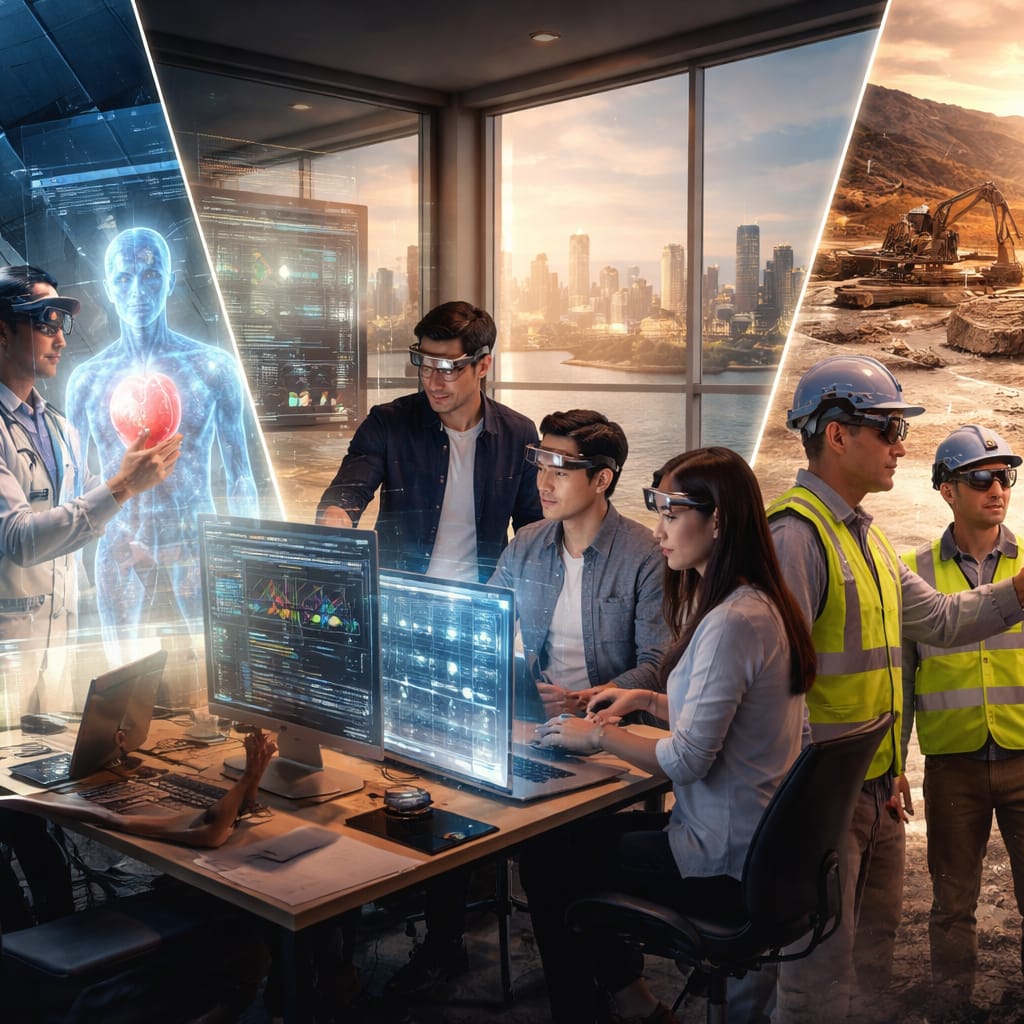
By 2026, AI and Software Development are reshaping augmented reality software solutions across Australian industries, from mining to healthcare and advanced training. Early adopters are already using custom AI applications to deliver safer, more efficient field operations supported by context-aware overlays. The primary shift is from static AR content to dynamic, data-driven guidance that responds to user intent, environment, and operational risk in real time. Modern computer vision models now support robust tracking in harsh outdoor conditions, including dust, vibration, and variable lighting typical of Australian worksites. As a result, organisations can standardise complex procedures directly within workers’ field of view, reducing reliance on printed manuals and ad hoc knowledge transfer.
AI-driven AR experiences are also changing how teams approach intelligent software development across the full lifecycle. Engineers must account for continuous data collection, labelling strategies, and secure deployment of updated models to edge devices such as smart glasses and rugged tablets. Rather than one-off releases, AR products evolve as live systems that learn from aggregated, privacy-preserving behavioural data. This creates a tighter feedback loop between operations, data science, and product teams, enabling faster iteration on guidance accuracy and UX flows. For Australian enterprises operating under strict regulatory expectations, this evolution demands an architectural focus on observability, resilience, and governance from day one.
In practice, many Australian organisations now frame AI Software Development for AR as a long-term capability, not a standalone project. Platforms must support both on-device inference for low-latency tasks and cloud inference for heavier analytics, while handling intermittent connectivity in regional and remote areas. To manage this complexity, teams are investing in modular services that encapsulate model training, feature extraction, and sensor fusion behind stable APIs. This approach enables independent scaling and experimentation without disrupting core operational workflows. It also lays the groundwork for introducing new sensors, wearables, or 3D displays as hardware evolves.
Evolution of AI-Driven AR Experiences
The next phase of AI-driven AR development centres on hyper-personalised guidance that adapts to skill level, context, and organisational policy. For example, junior technicians may see step-by-step animated instructions, while senior engineers receive higher-level diagnostics and exception alerts. By leveraging AI Software Development practices such as reinforcement learning from user interaction data, AR systems can refine which overlays are most effective in reducing errors and task duration. Australian hospitals are piloting clinical training simulations where AR-driven scenarios adjust complexity based on trainee performance over time. Meanwhile, resources companies experiment with digital twins that feed real-time plant data into AR interfaces for predictive maintenance.
- Real-time object detection and semantic segmentation tuned for Australian field conditions
- Context-aware overlays integrating sensor data, work orders, and safety procedures
- Federated learning pipelines to update models without exposing raw user data
- Cross-device spatial mapping to support multi-user collaboration in shared AR spaces
- Robust MLOps practices to monitor drift, performance, and AR guidance safety thresholds

Delivering robust AI-enhanced user experiences at scale requires careful attention to latency, reliability, and human factors. In construction and mining, overlays must remain stable under head movement, changing distance, and complex 3D geometry, while still providing clear visual hierarchy for critical warnings. Teams increasingly blend AI-driven AR development with human-centred design to avoid cognitive overload, especially in safety-critical tasks. Australian regulations on workplace safety and medical devices also necessitate rigorous validation regimes, including scenario-based testing and simulated failure modes. Organisations are establishing internal standards for AR visual language, error handling, and decision authority boundaries between human operators and AI recommendations.
In AI-first augmented reality, success depends less on individual models and more on the integrity of the full lifecycle—from data strategy and MLOps to user experience, safety governance, and ongoing performance monitoring in real operational environments.
Strategic Considerations for the Future of Intelligent AR
Looking ahead, the future of intelligent AR in Australia will be defined by how effectively organisations align technology strategy with operational realities. Investments in augmented reality software solutions must be paired with clear business cases around risk reduction, throughput gains, or training efficiency. Technical leaders should evaluate scalable AI AR frameworks that can support multiple use cases—inspection, training, remote assistance—on a shared spatial mapping and identity backbone. As machine learning in AR design matures, differentiation will come from domain-specific datasets, finely tuned user journeys, and tight integration with existing enterprise systems.
To stay ahead of 2026 trends, Australian enterprises should pilot targeted AI tools for AR apps while building a broader roadmap for next-gen AI development platforms. With the right combination of governance, engineering discipline, and cross-functional collaboration, organisations can turn AR from experimental pilots into mission-critical infrastructure. Now is the time to assess your current capabilities, identify high-value AR use cases, and partner with specialists who understand both real-time graphics and AI at scale. Take the next step by exploring how intelligent software development for AR can transform your operations, and initiate a discovery engagement to map a practical, phased rollout tailored to your environment.