
AI Software Development: How Smart Coding Assistants Will Transform Engineering by 2026
The rise of AI assistants in intelligent software development
By 2026, AI Software Development will be central to how engineering teams design, build, and maintain applications across Australia and globally. Modern platforms will embed AI assistants for developers directly into IDEs, terminals, and collaboration tools, guiding engineers from design through to deployment. These assistants will orchestrate repetitive tasks, connect project data, and enforce best practices without interrupting developer flow. Organisations investing early will gain a structural advantage in delivery speed, maintainability, and reliability. As AI becomes a standard layer in intelligent software development, teams will increasingly focus on system architecture, product strategy, and domain-specific problem solving rather than boilerplate code.
Day to day, custom AI applications will automate routine coding patterns, suggest optimal APIs, and refactor legacy modules with context-aware recommendations. Instead of manually wiring common frameworks, engineers will validate and refine AI-generated scaffolding tailored to their stack. Advanced models will also surface security concerns and performance anti-patterns before they reach production. Teams will treat these systems as always-on pair programmers, reviewing suggestions rather than starting from a blank file. Over time, this shift will reduce cognitive load and free developers to focus on deeper architectural and reliability considerations.
Testing and quality assurance will be transformed by automating software testing with AI across unit, integration, and end-to-end layers. Models trained on historical defects and production incidents will generate high-value test cases that target known risk areas. They will prioritise scenarios by business impact, helping teams concentrate on tests that materially protect customers and revenue. Continuous testing pipelines will dynamically evolve as code changes, ensuring coverage never silently regresses. This adaptive, risk-based testing strategy will drive more stable releases and shorter feedback loops between code changes and validation.
Smarter code generation, review, and collaboration by 2026
Code synthesis will progress from autocomplete to task-level generation, becoming a cornerstone of smart coding assistants 2026 initiatives. Developers will describe desired behaviours in natural language, diagrams, or contracts, and the assistant will propose end-to-end implementations aligned with project conventions. Generated code will include inline rationale and references to documentation, improving maintainability. Teams will still own design decisions, but implementation effort for standard workflows will fall sharply. This evolution will make prototyping, experimentation, and hypothesis testing significantly faster.
- Predictive analytics will use delivery history to forecast timelines, risk hotspots, and staffing needs.
- Context-aware assistants will perform AI-powered code review, flagging logic flaws, style issues, and potential vulnerabilities.
- NLP-driven interfaces will allow conversational queries about architecture, dependencies, and performance bottlenecks.
- Security-focused models will continuously scan repositories, pipelines, and dependencies for emerging threats.
- Adaptive learning paths will recommend resources and tasks to accelerate upskilling for each individual developer.
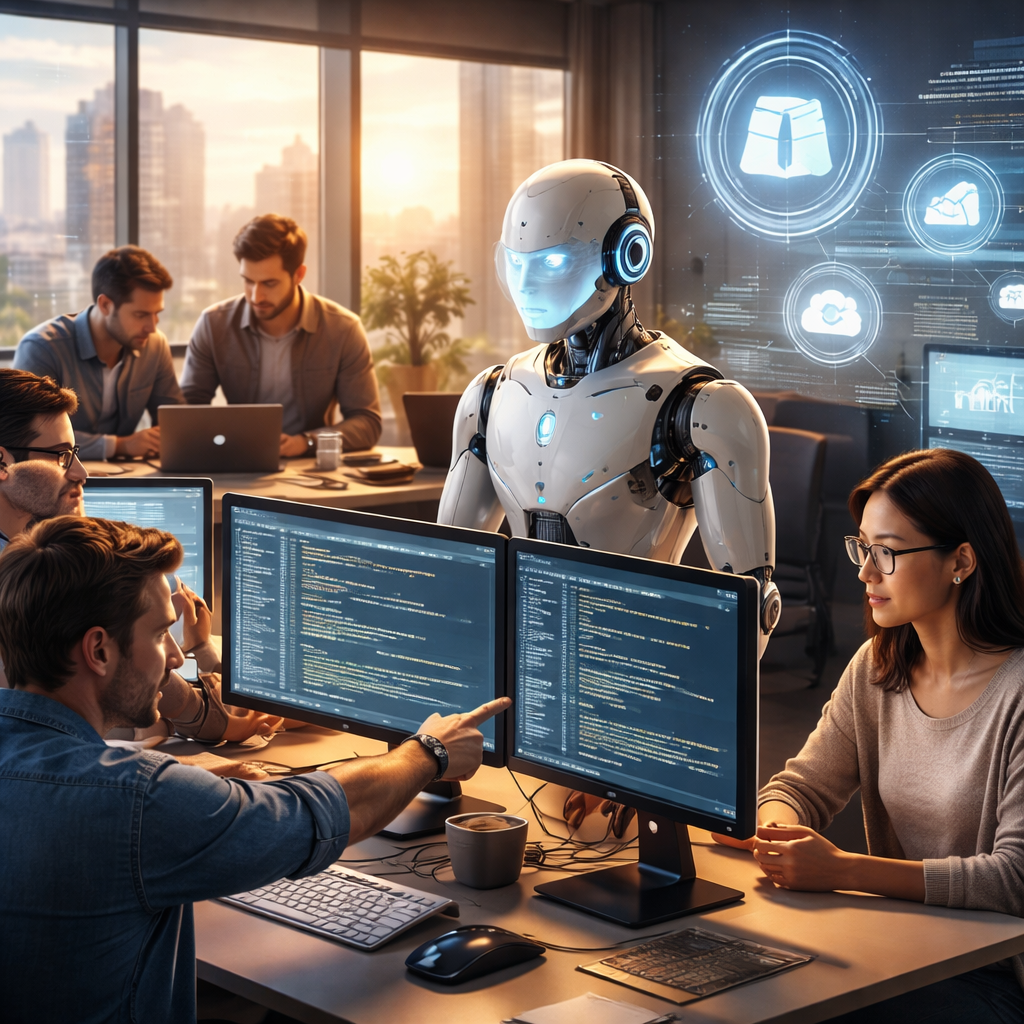
Industry research suggests AI assistants for developers could lift delivery speed by 20–30 per cent while simultaneously improving code quality. This gain will be realised through continuous guidance on patterns, instant access to project knowledge, and rapid triage of production issues. For organisations experimenting with AI-driven dev workflows, the emphasis will shift from “Can this tool write code?” to “How reliably does it improve our engineering outcomes?”. Success metrics will include escaped defects, cycle time, incident resolution, and onboarding speed. Firms that treat AI as a strategic capability, not a gadget, will see the strongest long-term benefits.
By 2026, the future of AI coding tools will be defined less by raw generation power and more by how safely, transparently, and predictably they integrate into everyday engineering practice.
Security, governance, and the future of AI coding tools
As adoption scales, teams will need clear guardrails for ethical AI in software engineering, covering data usage, transparency, and accountability. Tooling will log AI-suggested changes, offer reproducible explanations, and support audit trails for regulated industries. Organisations will combine machine learning in app development with human review, ensuring critical logic and safety controls remain under expert oversight. Governance frameworks will also address bias, intellectual property, and supplier risk. To prepare, engineering leaders should start piloting limited-scope AI coding initiatives now, building experience before these tools become indispensable.
If your organisation wants to stay ahead in intelligent software development, now is the time to formalise an AI adoption roadmap, establish clear engineering standards, and run structured pilots that prove value. Begin by targeting constrained, high-impact use cases such as security scanning, documentation generation, and AI-powered code review within non-critical services. From there, progressively expand to more complex workloads as confidence, tooling, and governance mature. The teams that learn fastest in this transition will set the engineering benchmark for the rest of the decade.