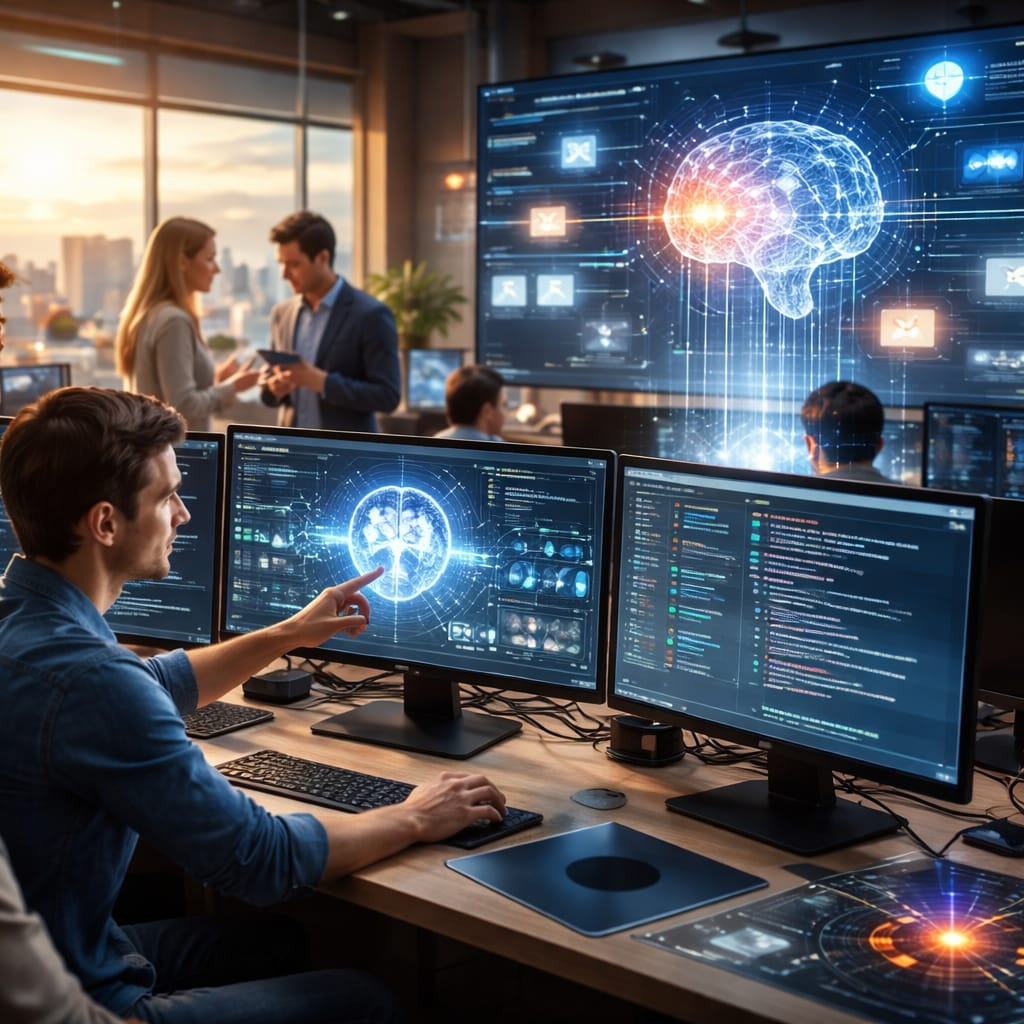
2026 Software Development: AI’s Role in Enhancing Software Integration
2026 Software Development and the Rise of AI-Powered Integration
By 2026, software development teams across Australia will rely heavily on AI-powered software integration to manage increasingly distributed, API-first ecosystems. As integration patterns grow more complex, organisations will depend on custom AI applications to keep services reliable, observable, and cost-efficient. AI will analyse traffic across APIs, event streams, and data pipelines, recommending configuration changes that improve throughput and resilience. This shift turns integration from a manual, error-prone effort into a continuously optimised capability embedded in the delivery pipeline. In parallel, leaders will treat integration as a product, with dedicated platform teams curating reusable templates, shared policies, and secure connectivity standards for the entire enterprise.
At the core of this evolution is intelligent software development that combines automation, analytics, and strong governance. Teams will use AI-assisted coding workflows to generate interface contracts, validate payloads, and assemble end-to-end test suites with minimal human intervention. These same AI services will monitor production behaviour, correlating logs, traces, and metrics to surface issues long before users are affected. As a result, developers can focus on higher-value design decisions rather than repetitive plumbing work. This professional, engineering-first approach will define how Australian organisations compete in a digital economy where integration speed and reliability are critical.
Modern integration platforms will embed AI Software Development capabilities as first-class features rather than optional add-ons. Developers will access pre-trained models that understand common patterns such as request-response, pub/sub, and event sourcing across microservices. These models will automatically flag anti-patterns like chatty APIs, excessive fan-out, or unbounded retries that threaten scalability. Over time, AI will learn organisation-specific norms, such as latency budgets or data residency constraints, and propose tailored optimisations. This tight coupling between development tooling and runtime intelligence will shorten feedback loops and increase confidence in changes.
AI-Driven Integration Patterns, Orchestration, and Observability
AI-driven integration tools will reshape how teams design, deploy, and operate microservices at scale. During design time, AI will infer data schemas, map fields between systems, and propose transformation logic that respects business rules and compliance boundaries. At runtime, orchestrators enhanced by machine learning in devops will dynamically rebalance workloads, route around failing endpoints, and adapt throttling policies based on real-time demand. These behaviours will be transparent and explainable, helping engineers trust automated decisions in production environments.
- Automated API contract generation and validation across heterogeneous systems
- Adaptive routing and rate limiting tuned by live latency and error signals
- Proactive anomaly detection spanning logs, traces, and metrics
- Self-optimising data mappings informed by usage and error patterns
- Continuous regression testing integrated into CI/CD pipelines for integrations

For platform teams, this means less time spent troubleshooting obscure integration faults and more time refining enterprise AI integration strategies. When an issue occurs, AI-driven observability will correlate symptoms across multiple services and environments, presenting a ranked list of probable root causes. Engineers can then apply targeted fixes, while the system learns from each incident to reduce recurrence. Over time, these insights will inform reference architectures and guardrails that developers inherit when building new services. This feedback-rich model will be central to automating software integration at scale.
By 2026, organisations that treat integration as an intelligent, AI-augmented product rather than a background task will deliver more resilient, secure, and adaptable digital platforms.
Security, Governance, and the Future of AI Development in Integration
As AI becomes deeply embedded in integration layers, security and governance must evolve to keep pace with the future of AI development. AI agents that can modify routing rules, authentication flows, or data transformation policies will require strict access controls and auditable decision trails. Policy engines will incorporate AI to perform continuous compliance checks, ensuring that data residency, privacy, and regulatory requirements are met across interconnected services. In regulated sectors, this will be essential to maintaining trust while still benefiting from automation.
Looking ahead, next-generation AI development platforms will combine low-code integration tooling with robust guardrails, giving engineering teams safe ways to exploit automation. Organisations will invest in training developers to understand model behaviour, interpret AI recommendations, and design secure integration patterns that resist abuse. Those that embrace AI-powered software integration early, embedding strong controls and observability, will reduce operational risk while accelerating delivery. To explore how this could work in your environment, consider engaging specialists in AI-driven integration tools and launching a targeted pilot across a high-value integration domain.