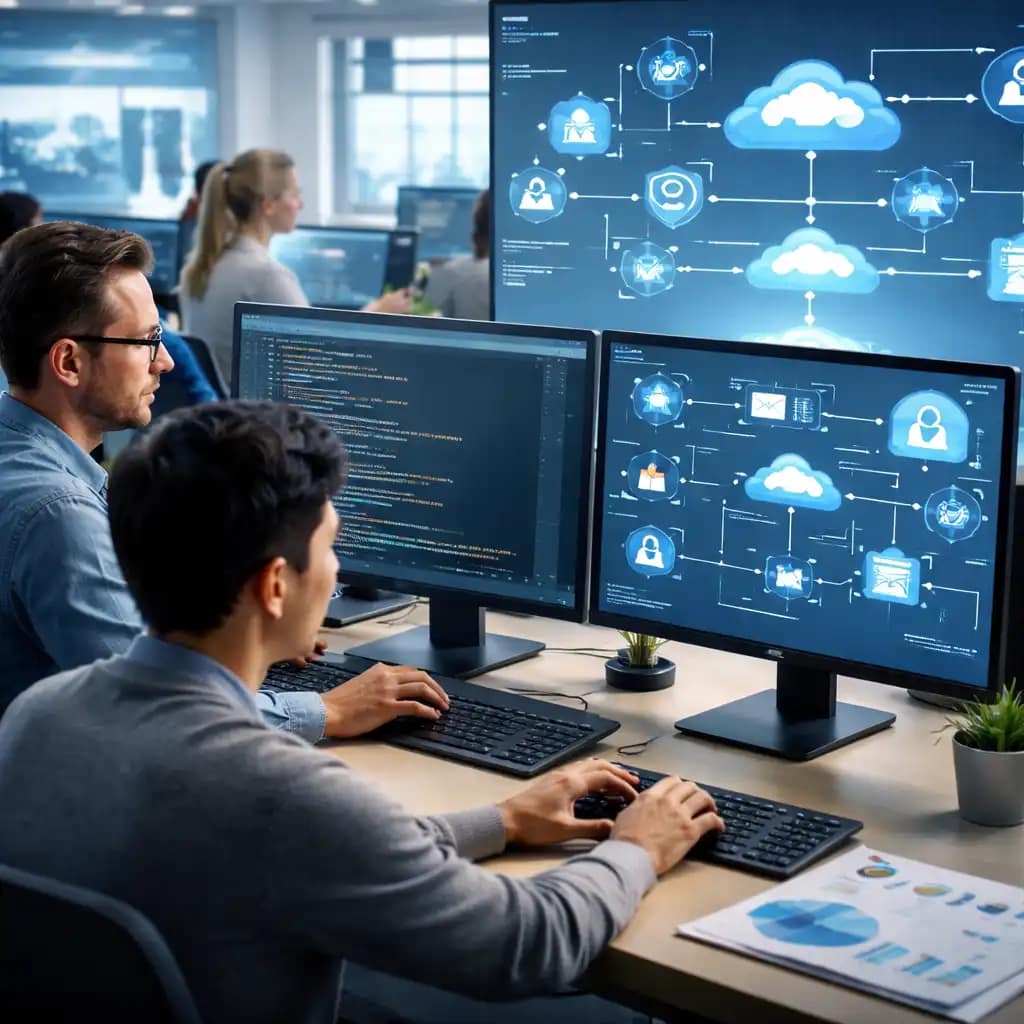
AI in Software Development: The Future of Team Dynamics in 2026
AI in software development is transforming how Australian engineering teams design, build, and operate digital products, reshaping team dynamics as much as technical workflows. By 2026, most developers will supervise AI systems that generate code, tests, and documentation, while humans focus on architecture, verification, and secure delivery. Early adopters already integrate AI into IDEs, CI/CD pipelines, and observability stacks, turning traditional coding efforts into higher‑level AI Software Development practices grounded in automation and data. This shift is driving deeper collaboration between software engineers, SREs, data scientists, and product leaders as they standardise prompts, patterns, and review rules. For Australian organisations, the strategic question is no longer whether to use AI, but how to embed it safely, consistently, and in ways that elevate overall engineering capability.
As AI tools grow more capable, development work is moving from manual implementation to supervisory engineering, where developers validate outputs rather than crafting every line themselves. This model unlocks substantial productivity, particularly when AI-assisted coding workflows are combined with robust testing and security automation. Junior engineers benefit from rapid feedback loops and on-demand explanations, while senior staff gain leverage by delegating boilerplate, refactoring, and regression tests to AI. At the same time, teams must guard against skill atrophy by pairing AI suggestions with deliberate practice, code walkthroughs, and design reviews. Organisations that treat AI as a probabilistic assistant, not an infallible oracle, are better positioned to retain deep expertise while scaling delivery.
AI-Driven Team Dynamics and Role Evolution in 2026
Within modern squads, AI in software development is changing who does what, when, and with which tools, prompting updates to role descriptions, career paths, and training frameworks. Developers increasingly specialise in systems thinking, security modelling, and integration, while AI handles repetitive scaffolding, data access layers, and documentation stubs. Tech leads focus more on intelligent software development strategy, deciding which models to trust, how to govern them, and where to place human review gates. Product owners learn to estimate work based on orchestration complexity rather than raw lines of code, improving predictability in multi-team delivery. Meanwhile, platform and DevOps engineers expand their remit to cover model deployment, monitoring, and policy enforcement. This evolution demands continuous learning programs, pair-review norms, and structured experimentation so that teams remain confident in both their human expertise and their AI-augmented workflows.
- Establish organisation-wide standards for prompts, code review, and AI-powered code quality checks.
- Pilot collaborative AI pair programming practices that pair juniors with seniors and AI tools.
- Strengthen security, privacy, and ethical AI use in development through clear governance.
- Invest in training that balances hands-on coding skills with supervisory engineering capabilities.
- Measure outcomes via productivity, reliability, and developer wellbeing, not only activity metrics.

For Australian teams, the future of AI coding tools will be defined by governance, inclusivity, and the ability to align automation in agile development with business value. Leaders should run time-boxed experiments across varied squads, tracking impacts on delivery lead time, incident rates, and developer satisfaction. Cross-functional forums can share patterns for custom AI applications, ensuring knowledge does not remain siloed with a few enthusiasts. Equally, security and compliance stakeholders must shape policies for data access, logging, and model selection so that machine learning in dev teams remains auditable. Over time, AI-driven software project management will rely on rich telemetry from code, pipelines, and production systems to support nuanced, risk-aware decisions.
Teams that treat AI as a disciplined engineering practice, not a novelty plugin, will set the benchmark for speed, safety, and reliability in 2026.
Preparing Australian Engineering Teams for AI at Scale
To prepare for AI in software development at enterprise scale, Australian organisations should embed AI-aware rituals into backlog refinement, sprint planning, and post-incident reviews. This means explicitly identifying opportunities for AI-powered code quality checks, test generation, and documentation each iteration. Teams can then refine guardrails when AI output fails, improving both model prompts and human review checklists over time. Clear guidelines on ethical AI use in development, data residency, and model transparency help maintain trust across stakeholders. Ultimately, leaders who align AI strategy with culture, skills, and long-term architectural direction will convert experimental wins into durable, organisation-wide capability, keeping their engineering function competitive in a rapidly evolving landscape.
Now is the time to assess your current practices, define a roadmap, and build the capabilities needed to harness AI responsibly. If you want to accelerate your journey with practical guidance, consider partnering with specialists who understand Australian regulatory settings, sector-specific risks, and modern AI-assisted coding workflows. By acting early, you can shape how your teams collaborate with AI, instead of reacting to fragmented, bottom-up adoption. Take the next step today: convene your engineering, security, and product leaders, identify your highest-value AI opportunities, and launch a focused pilot that proves what an AI-augmented software organisation can achieve.