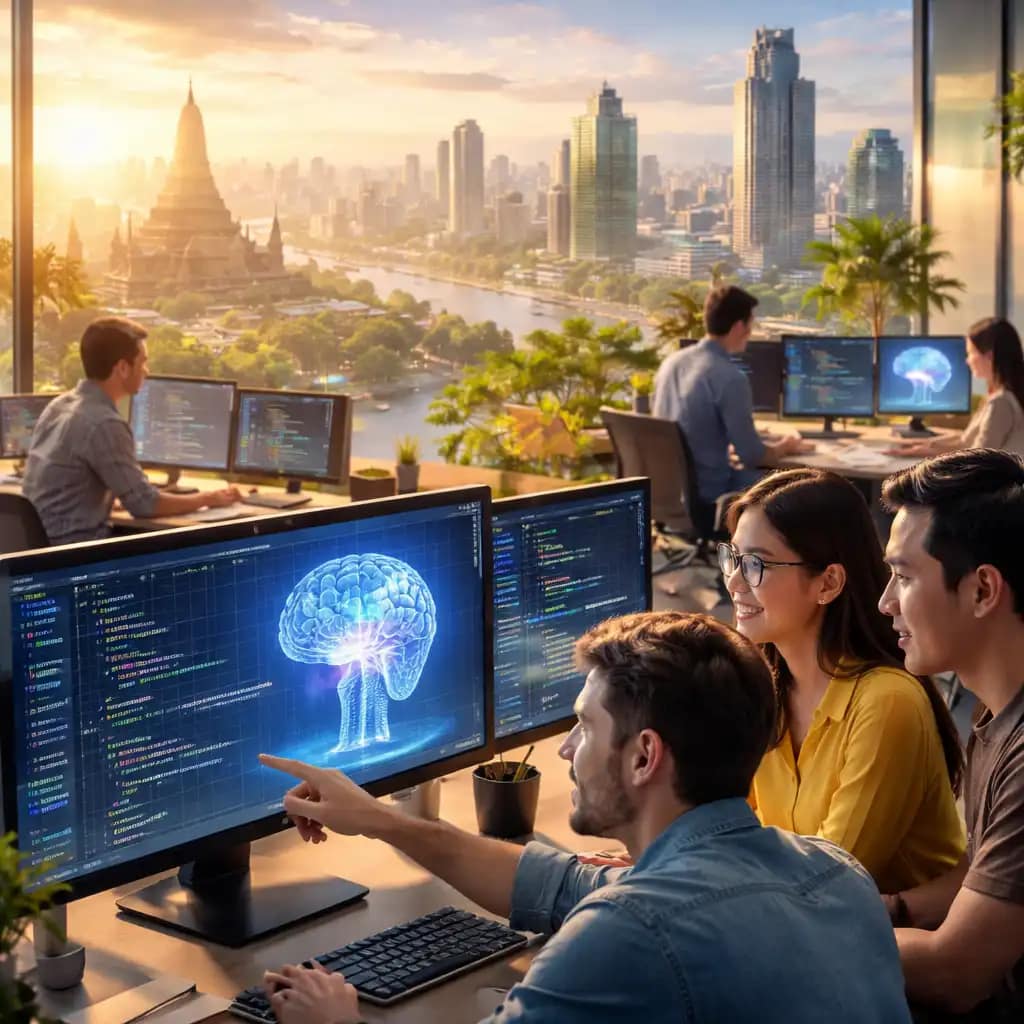
AI in Software Development by 2026: Transforming the Engineering Landscape
AI in software development by 2026 will fundamentally reshape how engineering teams design, build, test, and maintain applications across Australia and globally. As AI-assisted software engineering matures, developers will increasingly delegate repetitive and low-level tasks to highly capable models, while focusing on architecture and product strategy. Intelligent code assistants will move beyond simple autocomplete to perform large-scale refactoring, cross-service impact analysis, and context-aware debugging. These assistants will help teams implement automation in code creation, including generating unit, integration, and property-based tests aligned with business rules. Modern pipelines will embed AI-enhanced software lifecycle capabilities, enabling continuous quality monitoring across performance, security, and reliability. In this environment, organisations that embrace AI Software Development practices early will gain a measurable competitive advantage in delivery speed and code robustness.
By 2026, development environments will evolve into adaptive, context-sensitive workspaces tuned to individual engineers and project domains. IDEs will leverage machine learning in dev workflows to recommend libraries, frameworks, and design patterns based on code history, team conventions, and regulatory constraints. For example, when working on a high-availability fintech service, the environment may prioritise suggestions for resilient patterns and audited cryptographic libraries. These smart workspaces will also provide real-time architectural feedback, flagging potential scalability or observability issues as code is written. Teams will rely on AI-powered development tools to generate environment-specific configuration, deployment manifests, and rollback strategies. Such capabilities will reduce cognitive load, allowing developers to spend more time on domain modelling and stakeholder communication. Over time, this shift will redefine what effective and intelligent software development looks like.
AI-Driven Collaboration, Security, and Ethical Governance
Collaboration within engineering teams will be transformed by AI-enhanced communication and analytics layers embedded in day-to-day tools. Meeting platforms will provide automatic summarisation, action extraction, and architectural decision records, ensuring design intent is captured without manual minutes. Project analytics will correlate commit patterns, incident data, and deployment metrics to highlight systemic bottlenecks and ownership gaps. On the security side, intelligent systems for developers will continuously scan code, dependencies, and infrastructure-as-code for vulnerabilities, proposing contextual fixes that align with existing patterns. This proactive stance will drastically reduce mean time to remediation and limit exploitable windows in production systems. At the same time, ethical AI governance will become a core engineering discipline, with teams required to document model provenance, training data lineage, and bias mitigation strategies. Organisations will formalise review boards and risk frameworks to ensure responsible operation of custom AI applications in safety-critical domains.
- Intelligent code assistants will autonomously refactor large codebases while maintaining behavioural parity.
- Continuous testing pipelines will rely on generative models to create and evolve extensive test suites.
- AI-driven security scanners will provide prioritised, explainable remediation guidance for vulnerabilities.
- Adaptive IDEs will personalise workflows, shortcuts, and recommendations for each developer and project.
- Governance frameworks will define standards for transparency, accountability, and regulatory compliance in AI models.

The future of intelligent coding will also reshape the software engineering workforce, demanding new skills and mindsets from practitioners. Developers will be expected to understand model behaviour, prompt design, and evaluation metrics alongside traditional programming competencies. Next-generation AI dev platforms will expose configurable policies that control how models access repositories, secrets, and runtime telemetry, requiring engineers to balance productivity with risk. Teams will design workflows where humans validate critical decisions while delegating routine changes to AI agents under strict guardrails. This hybrid approach will increase throughput without sacrificing safety or maintainability. In parallel, organisations will invest in training programs to build literacy around data ethics, model drift, and monitoring of AI-powered systems in production. Career paths will expand to include AI platform engineers, model ops specialists, and governance leads embedded within delivery squads.
By 2026, the most successful engineering organisations will be those that treat AI not as a novelty, but as a disciplined layer in their software delivery lifecycle, with clear responsibilities, controls, and measurable outcomes.
Preparing Engineering Teams for AI-First Delivery
To prepare for this shift, Australian organisations should start piloting AI-assisted workflows in controlled, high-observability environments. A practical step is to introduce AI-assisted software engineering for non-critical refactors or documentation generation, measuring impact on cycle time and defect rates. Teams can then expand usage to more advanced tasks, including test generation, performance tuning suggestions, and guided incident response. Establishing internal guidelines around prompt libraries, code review expectations, and audit logging will help standardise safe adoption of AI-powered development tools. Finally, engineering leaders should frame this evolution as capability augmentation rather than replacement, emphasising that human judgment, domain expertise, and cross-functional collaboration remain central. By taking a structured, experimental approach today, organisations will be well positioned to harness AI Software Development practices for secure, reliable, and innovative digital products. Now is the time to upskill teams, modernise toolchains, and define governance so your organisation can lead in this AI-first era.