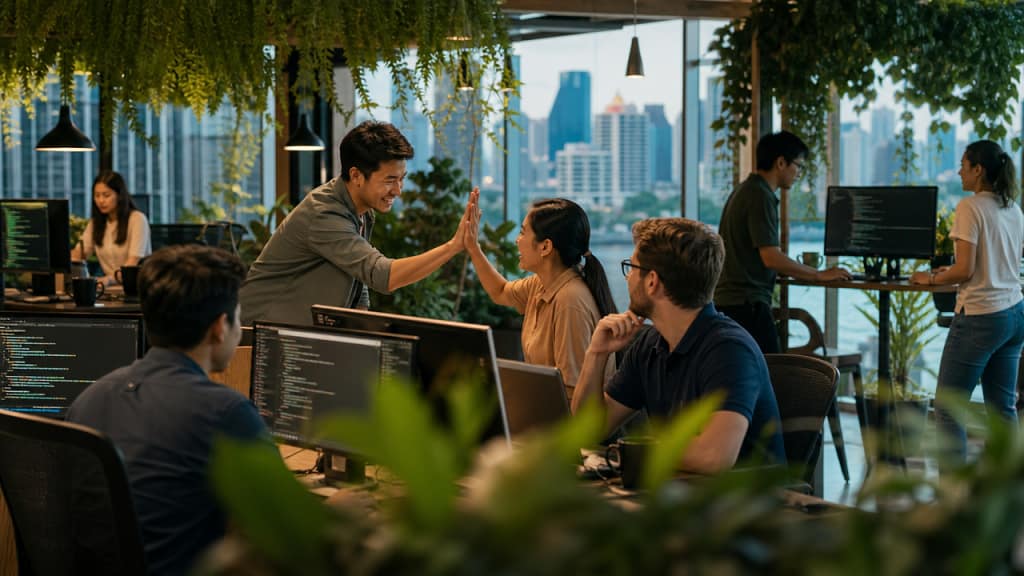
By 2026, AI in software development is transforming how Australian engineering teams collaborate in real time, both in IDEs and across chat-based workspaces. Adoption of real-time AI coding tools now extends to the vast majority of professional developers, who increasingly rely on AI to generate code, interpret complex legacy systems and surface documentation without breaking flow. This shift underpins a broader movement towards AI-powered dev collaboration, where human engineers orchestrate AI capabilities rather than executing every task manually. As more organisations embed AI directly into their SDLC, they are also turning to AI Development Services to design secure, scalable and compliant platforms that align with local regulatory expectations. These services often extend beyond tooling, covering governance, observability and change management to ensure AI support enhances rather than disrupts existing workflows. The result is a more data-driven, automated and resilient engineering environment for high-performing teams.
Conversational programming sits at the centre of this change, with developers iteratively describing requirements to collaborative intelligent code assistants that can refine outputs in seconds. Instead of trawling through codebases, engineers now offload comprehension, debugging and refactoring to AI, reserving human judgement for architectural and product decisions. This enables tighter integration across product, design and engineering, as non-technical stakeholders can participate directly through natural language interactions. When coupled with AI-driven agile workflows, cross-functional teams gain richer context on trade-offs and dependencies, reducing miscommunication and rework. Australian organisations are also exploring custom AI applications that integrate with internal repositories, ticketing systems and observability stacks. This allows project-specific knowledge to inform decisions, while retaining strict access control and logging. Such integrated approaches support clearer ownership and promote sustainable engineering practices over quick but risky automation wins.
AI in Software Development: Trends in Real-Time Collaboration for 2026
Another major development is the rise of agentic workflows and multi-agent systems embedded across CI/CD pipelines and next-gen AI dev environments. Rather than relying on a single monolithic assistant, teams orchestrate specialised agents focused on testing, documentation, performance optimisation and security analysis. When configured correctly, these agents can shorten pull request cycles through automated, real-time AI code review that flags potential defects before human evaluation. Organisations report substantial gains in throughput and reliability, especially when these agents are aligned with clear coding standards and review policies. However, real-world case studies also highlight the importance of explicit accountability for AI-generated artefacts, supported by robust logging and traceability. Without disciplined processes, the benefits of intelligent software development can be undermined by fragmented ownership, duplicated work and subtle defects that slip past insufficiently trained models.
- Establish clear coding standards that all AI agents must follow, including formatting, security and performance conventions.
- Mandate human review for all AI-generated code and configuration, with explicit sign-off and traceable ownership.
- Integrate AI pair programming platforms directly into IDEs and CI tools to minimise context switching.
- Instrument AI-assisted changes with enhanced observability and logging to support audits and incident investigations.
- Continuously retrain and calibrate models based on production feedback, defect patterns and evolving business requirements.

These advances also introduce new risks, particularly around invisible work, team cohesion and long-term maintainability. Developers frequently spend significant time validating suggestions from AI Software Development tools, ensuring outputs align with business rules, security constraints and performance expectations. If this validation effort is not tracked, leaders may overestimate capacity and inadvertently drive burnout. There is also a danger that over-reliance on agents could weaken direct peer communication and shared architectural understanding. To counter these issues, Australian teams are strengthening engineering enablement practices that keep humans at the centre of decision-making. Strategies include rotating stewardship of critical systems, pairing engineers for high-risk changes and running regular architecture reviews to preserve shared context.
AI should act as an amplifyer for professional judgement, not a replacement for it; the most successful teams design their workflows so humans remain accountable for every production outcome.
Preparing Australian Teams for AI-Enhanced Software Delivery
To fully realise AI-enhanced software delivery, organisations must treat AI adoption as an engineering initiative, not just a tooling rollout. This starts with clear governance policies for secure AI usage, including data residency, access control and prompt sanitisation. Mature teams integrate AI into quality gates, ensuring automated checks run alongside human review across the SDLC. Others embed real-time telemetry to understand how AI-driven recommendations impact incident rates, latency and user experience. Forward-leaning companies are combining these controls with AI-powered dev collaboration patterns that emphasise transparency, such as shared chat histories and reproducible decision trails. As more workloads move into cloud-native architectures, carefully designed AI Development Services become critical to orchestrate agents, maintain compliance and adapt platforms as regulations and technologies evolve. Australian software leaders who invest now in governance, enablement and measurement will be best positioned to deliver resilient, secure and innovative systems at scale.