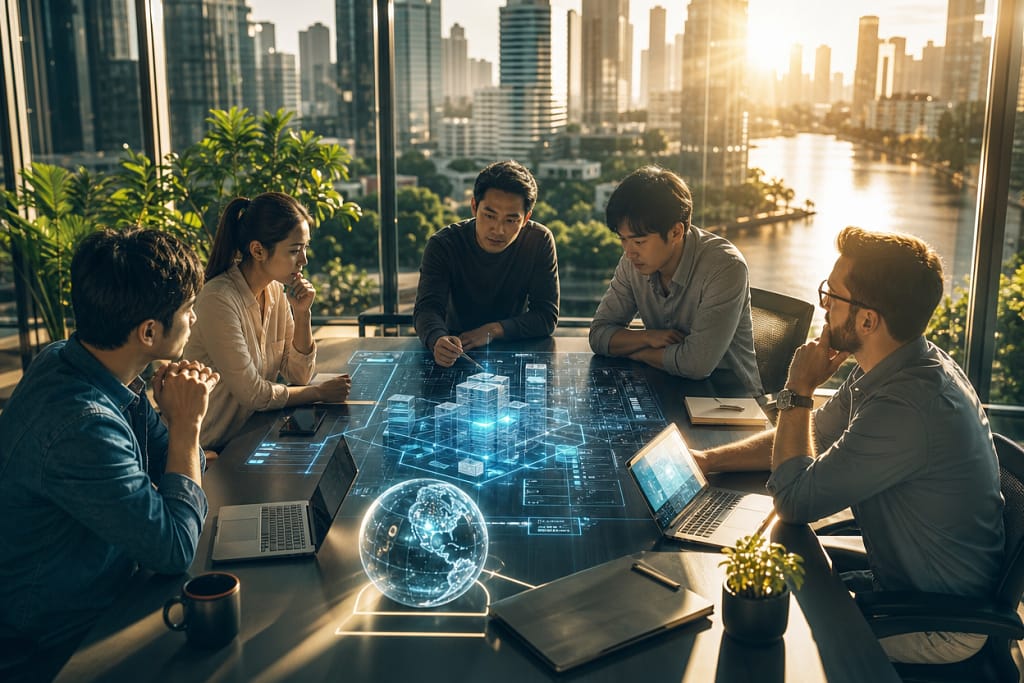
The future of coding in Australia is rapidly evolving as artificial intelligence reshapes how engineers design, build, and maintain software systems. By 2026, the primary shift will be from manual, line‑by‑line coding towards intelligent software development workflows guided by data and automation. Developers will increasingly rely on AI-powered coding tools to generate, refactor, and review source code with high accuracy and speed. This transition is not about replacing engineers, but about augmenting their capabilities so they can focus on architecture, security, and reliability. Teams will adopt AI tools for developers as standard components of their engineering toolchains, much like version control and continuous integration today. As these tools mature, Australian organisations will demand stronger engineering practices to manage model outputs and ensure code quality. The companies that adapt fastest will gain a strategic edge in software delivery, innovation, and long‑term maintainability.
By 2026, AI-assisted code generation will be embedded in every stage of the coding workflow, from initial prototypes through to production-ready services. Engineers will describe requirements in structured natural language, and models will translate these into consistent, testable components. For repetitive tasks, such as writing integration layers or data transformation pipelines, automating software development will dramatically reduce cycle times. Senior engineers will move from writing most of the code themselves to curating, validating, and optimising AI‑generated output. This will demand stronger skills in code review, threat modelling, and performance analysis. At the same time, teams will need clear governance policies to prevent accidental exposure of sensitive code or data to external models. Organisations that define robust guardrails will unlock significant productivity while maintaining compliance, resilience, and technical quality across their platforms.
The future of AI programming in software teams
As AI models grow more capable, the future of AI programming will centre on orchestrating multiple specialised systems rather than relying on a single general model. One model might handle secure authentication flows, another might specialise in database query optimisation, and another in UI component generation. These models will integrate with modern CI/CD pipelines, enabling an AI-driven software lifecycle that continuously analyses performance metrics and suggests targeted improvements. In complex environments, machine learning in devops will automatically detect anomalies, capacity issues, and configuration drift before they cause outages. Australian engineers will still define service boundaries, API contracts, and resilience patterns, but they will offload much of the implementation detail to automated systems. Over time, teams will build custom AI applications tuned to their domain, encoding hard‑won expertise into reusable agents and templates. This will create a powerful feedback loop where operational data continually sharpens development practices and platform reliability.
- Use AI-powered coding tools to generate boilerplate and repetitive logic while engineers focus on domain-specific complexity.
- Adopt next-gen AI development workflows that integrate models into planning, coding, testing, and release pipelines.
- Leverage AI Development Services to design secure, scalable architectures that align with organisational standards.
- Implement governance frameworks to manage access, data privacy, and validation of AI-generated code artifacts.
- Train teams on AI tools for developers so they can interpret suggestions, detect model errors, and maintain code ownership.

Security and ethics will be central concerns as AI takes on more responsibility in production systems. Models will be able to scan repositories for vulnerable dependencies, weak cryptography, and insecure patterns with far greater coverage than manual reviews. As AI Software Development practices mature, teams will embed automated policy checks that enforce encryption standards, access controls, and data minimisation by default. However, reliance on models also introduces new attack surfaces, including prompt injection and data exfiltration vectors. Australian organisations will require strong auditing, versioning, and traceability for all AI-generated artefacts to satisfy regulatory expectations. They will also need processes to identify and remediate bias in recommendation systems and decision logic. Ethical guardrails will not be optional; they will be fundamental to maintaining trust with customers, regulators, and internal stakeholders in a heavily automated ecosystem.
By 2026, the most effective engineering teams will be those that treat AI as a disciplined, testable component of their stack, not a shortcut that bypasses sound software engineering principles.
Building resilient AI-driven engineering capabilities
To realise these benefits, Australian organisations should invest now in structured capability building and modern engineering practices. This includes training developers to understand how generative models work, where they fail, and how to design safe integration patterns. It also means implementing rigorous test suites and observability so AI-generated changes can be validated continuously in realistic environments. Partnering with specialised AI Development Services can accelerate this journey, providing expertise in model selection, infrastructure, and security hardening. Over time, engineering leaders will measure success not only by delivery speed, but by how effectively AI-enhanced workflows improve reliability, scalability, and maintainability. Teams that proactively define roles, standards, and guardrails will be well placed to compete in an era dominated by intelligent, data‑driven software systems.